

Measure Chest First: Unisex T Shirt Fit for Shoppers and Merch
Unisex t-shirts run on a men’s pattern block, so they are boxier and roomier than most women’s cuts at the same labeled size. The practical rule: men order their usual unisex size, women often size down one (sometimes two for a fitted look), and everyone should check the flat measurements on the size chart before checkout. Get the chest number right first. Everything else, including length, tends to sort itself out.
TL;DR:
- Unisex t-shirts are based on men’s sizing, with women advised to size down one or two for a closer fit, but brand variance exists.
- Flat measurements are key; double the flat chest measurement for accurate size comparison against body measurements, especially when choosing between two sizes.
- The typical chest ease built into unisex tees ranges from zero to three inches for a standard fit and over three inches for oversized styles.
- Fabric quality and washing habits significantly affect fit after washing; sizing up slightly for cotton and shrinking less in blends can help maintain desired fit.
- Checking detailed flat measurements and fit definitions on product pages before ordering minimizes returns and ensures better satisfaction.
Table of Contents
- How Do You Convert Sizes Between Unisex, Men’s, and Women’s Shirts?
- Why Does Unisex Fit Different Than Men’s or Women’s Cuts?
- How Do You Measure Yourself and a T-Shirt for the Right Unisex Size?
- Which Fit Label Should You Choose, and What Changes for Group Orders?
- Will Fabric and Shrinkage Change the Fit After You Wash It?
- What Should You Check on a Product Page Before You Buy?
- The Mistake Most Shoppers Make Buying Unisex Tees Online
- Find Your Fit in Gulfofamerica’s Patriotic Gear
- Sources
How Do You Convert Sizes Between Unisex, Men’s, and Women’s Shirts?
Unisex t-shirt sizing borrows its foundation from men’s sizing, then flattens the grading so one chart covers a wider range of bodies. That’s the whole story behind why a “medium” can feel like a small on one person and a loose large on another. The conversion pattern most merch and blank suppliers use has women sizing down one full size from their normal women’s fit, and sometimes two if they want a snug, tailored silhouette rather than a relaxed drape.
Here’s the catch nobody mentions enough: that conversion is a starting point, not a guarantee. Brand variance is real. A unisex medium from one supplier can measure closer to a men’s small from another, because there’s no single legal or industry definition forcing every label to mean the same thing.
Before trusting any chart, understand the difference between two numbers that look similar but aren’t:
- Flat garment measurements are what you get when the shirt is laid flat and measured directly, like armpit to armpit for chest width.
- “To fit” body measurements describe the body size the shirt is designed to cover, already accounting for ease.
Mixing these up is the single most common reason people order the wrong size. A chart listing “38 inch chest” might mean the body it fits, not the shirt’s flat width, which would actually be around 19 inches side to side.
A simplified example of how a unisex chart typically reads:
Double the flat chest number to get the circumference, then compare it to your own chest measurement plus the ease you want. That single move eliminates most of the guesswork before you ever pick a size on a product page.
Why Does Unisex Fit Different Than Men’s or Women’s Cuts?
The short answer is pattern geometry. Women’s tees are cut with a fitted or contoured block, tapering in at the waist and sitting closer to the body through the torso. Men’s blocks run straight down from chest to hem with minimal taper. Unisex patterns almost always start from that straight men’s block, sometimes softened slightly at the side seam, but rarely tapered enough to read as fitted.
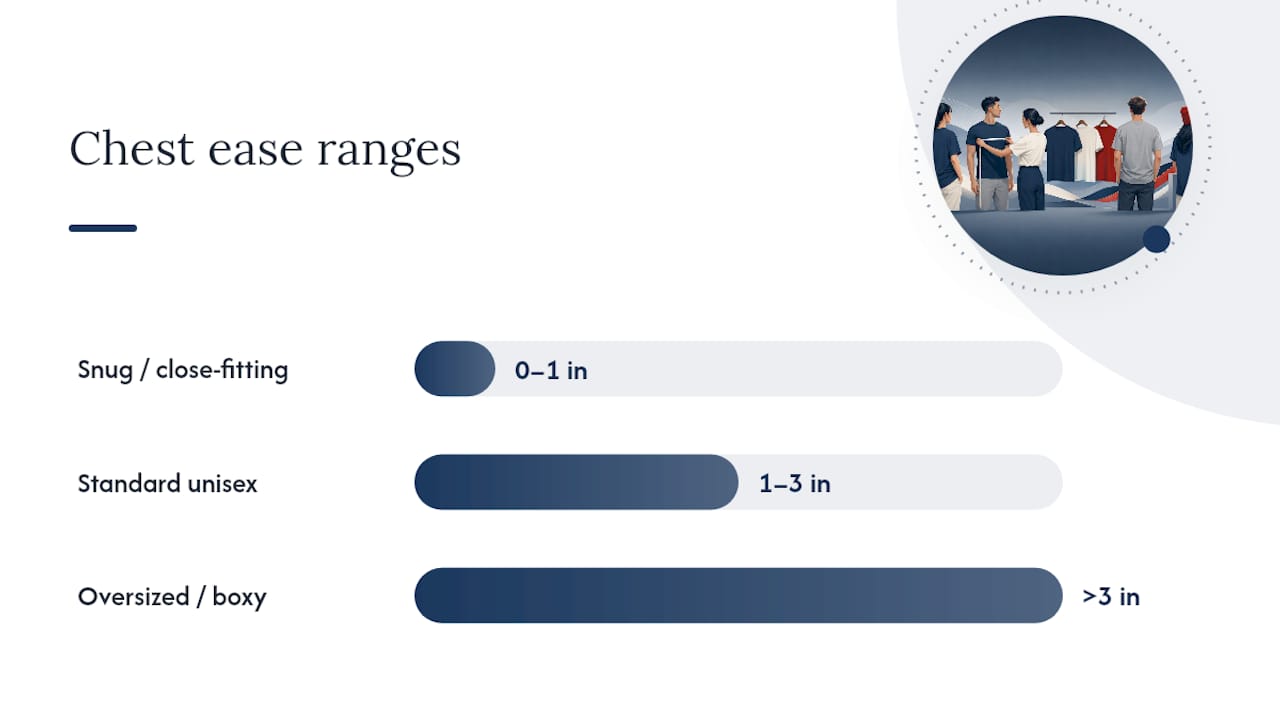
That straight cut is where “chest ease” comes in, and it’s the number that actually explains why a shirt feels roomy even when the size label matches your chest measurement.
Chest ease, explained simply: Many mainstream unisex lines build in a modest amount of ease for a size medium to ensure comfort and movement., meaning the finished garment measures about that much wider than the body it’s designed for. That’s not a flaw. It’s intentional, giving the shirt room to move and layer.
What that 2.5 inches feels like in practice:
- A snug, close-fitting tee usually has 0 to 1 inch of ease.
- A standard, comfortable unisex tee sits in the 1 to 3 inch range.
- An oversized or boxy style pushes past 3 inches, sometimes well past it.
Shoulder width and shirt length compound the effect. Unisex patterns typically extend the shoulder seam slightly wider than a women’s cut and add extra length at the hem, so even at identical chest ease, a unisex shirt can look bigger overall simply because it covers more of the arm and torso. Shoulder slope and sleeve cap height also change how a shirt drapes. Two shirts with an identical chest measurement can hang completely differently depending on those two details, which is one reason a “medium” from two different brands rarely feels the same on the same body.
How Do You Measure Yourself and a T-Shirt for the Right Unisex Size?
Skip the guesswork and take three measurements on your own body before comparing anything to a chart.
- Measure your chest at its fullest point. Wrap a soft tape around your body, level under the arms, and keep it snug but not tight.
- Measure shoulder point to point. Go straight across your back from one shoulder edge to the other, following the seam line you’d expect a shirt to sit on.
- Decide your preferred length. Measure a shirt you already like from the high point of the shoulder down to the hem, and use that as your target.
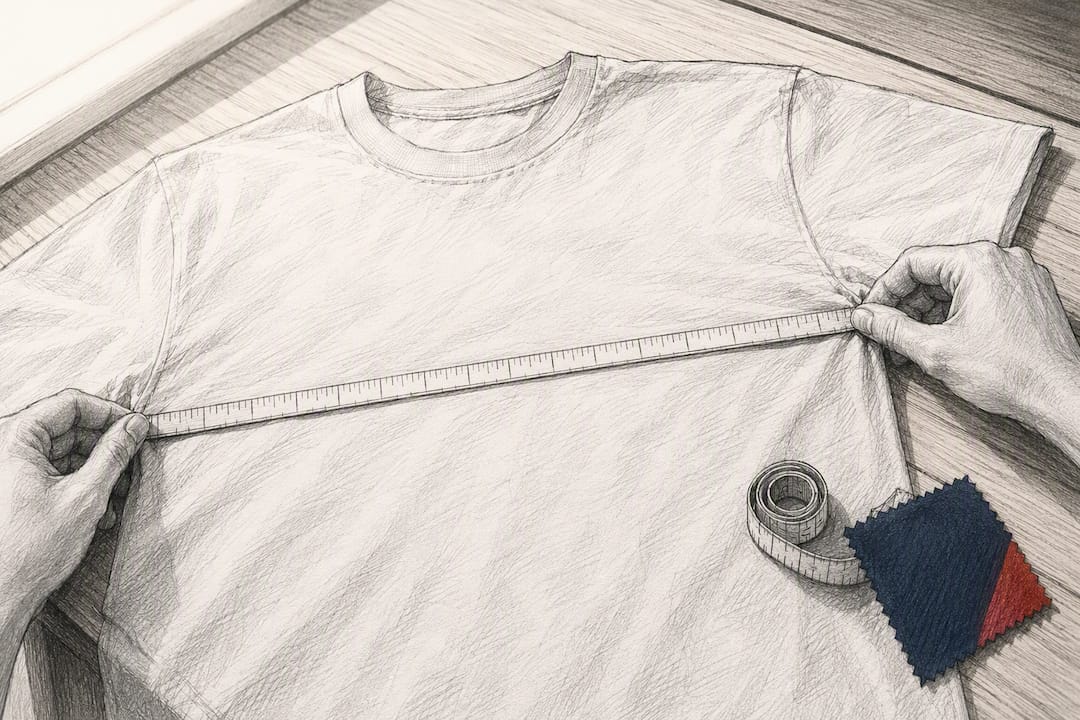
Once you have your own numbers, measure a t-shirt you already own and love the fit of, laid flat on a table. Measure armpit to armpit for the chest, then double that number to get the actual circumference. Do the same across the shoulders and down the length. Comparing those numbers to a brand’s published chart tells you far more than the size label ever will, and the same flat measurement method works whether you’re checking a shirt for yourself or sizing a whole order.
When a size chart forces a choice between two sizes, prioritize the chest number over length. Length is more forgiving. A shirt that runs an inch long still works fine tucked in or with a slight roll; a shirt that’s tight across the chest never really wears comfortably no matter what you do to the hem.
A quick ease checklist for choosing between two close sizes:
- Close fit target: 0 to 1 inch of ease over your chest measurement.
- Standard, everyday target: 1 to 3 inches of ease.
- Oversized or streetwear target: 3 inches or more.
Pro Tip: If you’re ordering for layering, whether that’s a hoodie over a tee or a jacket in cooler months, size up rather than down. A shirt with a little extra room under a layer reads fine; one that’s too tight becomes a daily annoyance.
Which Fit Label Should You Choose, and What Changes for Group Orders?
Fit labels sound simple until you realize half the industry uses them loosely. Here’s what each one actually tends to mean on a hang tag:
- Standard or classic fit: the default unisex cut, straight through the body with moderate ease, generally in the 1 to 3 inch range described above.
- Semi-fitted: slightly tapered at the side seam, splitting the difference between a boxy unisex block and a true women’s cut.
- Relaxed or oversized: deliberately loose through the chest and body, often 3 or more inches of ease, designed to be worn baggy on purpose.
- Slim fit: tapered through the torso with minimal ease, closer to 0 to 1 inch, and the closest a unisex tee gets to a fitted women’s silhouette.
The practical sizing rule holds across most brands: men typically stick with their normal unisex size, and women size down one from their usual number, sometimes two if the goal is a tailored, close-to-the-body look rather than a relaxed drape. The exception is retail-fitted blanks. Some suppliers already run slim through the body even in unisex sizing, so sizing down again on top of that can land too tight. Always cross-check the flat measurements rather than assuming the rule applies uniformly.
For merch and group orders, unisex is usually the right default because it simplifies logistics and fits the widest range of people without stocking multiple pattern blocks. That said, offering an optional women’s cut alongside the unisex base tends to improve satisfaction on mixed-group orders without complicating the ordering process much at all. If your group leans heavily toward a fitted preference, running a quick 10-person fit test with the actual brand you plan to order from beats guessing from a chart alone. If your event or team order needs fast turnaround and proofing on top of good fit guidance, that’s worth factoring into which supplier you pick, not just the size chart itself.
Will Fabric and Shrinkage Change the Fit After You Wash It?
The size you order on day one isn’t necessarily the size you’re wearing after the third wash. Cotton garments typically shrink about 3 to 5 percent the first time they’re washed, and that shrinkage tends to hit length more noticeably than chest width.
What that 3 to 5 percent looks like in real numbers: on a shirt with a 28 inch length, a 5 percent shrink pulls off more than an inch. Order a size expecting a specific hem length, and that shirt might land noticeably shorter after laundering.
Fabric composition changes how much of that risk you’re actually taking on:
- 100% ring-spun cotton tends to shrink the most and drapes softly once broken in.
- Tri-blend fabrics (cotton, polyester, rayon) shrink less and hold their shape better wash after wash.
- Heavier cotton weights (6 ounce and up) resist shrinkage better than lightweight tees but feel structured rather than fluid.
To protect the fit you paid for, wash cold, skip the high-heat dryer cycle, and air-dry when you can. If you already know you’re buying 100% cotton and prefer a relaxed silhouette long term, sizing up slightly from your measured number gives the fabric room to shrink into the fit you actually want, rather than out of it.
What Should You Check on a Product Page Before You Buy?
Every product page should show you the same two things: a full flat-measurement chart and clear guidance on how the brand defines its own fit. Many apparel pages list flat garment measurements, chest and length, so shoppers can skip the guesswork and compare a shirt they already own instead of trusting a size label alone.
The move that saves the most returns: grab a tee from your closet that fits the way you want, measure it flat, and hold that number up against the chart before you check out. If you’re between two sizes, lean toward sizing down for a closer, standard fit or up if you want room for shrinkage and layering. Gulfofamerica backs every order with a 30-day money-back guarantee, so a size that doesn’t land right isn’t a dead end. It’s a quick exchange, not a wasted purchase.
The Mistake Most Shoppers Make Buying Unisex Tees Online
The single biggest fix in this whole guide is boring: measure a shirt you already love, flat, before you order anything new. Almost every bad unisex purchase traces back to trusting a size label instead of a tape measure.
Two mistakes show up constantly. First, shoppers assume “unisex medium” means the same thing across every brand, when the pattern base and grading behind that label vary widely from one supplier to the next. Second, people fixate on length and ignore chest ease, when chest is the harder measurement to fix after the fact. A shirt that’s slightly long can be tucked or hemmed for a few dollars. A shirt that’s tight across the chest just isn’t comfortable, full stop.
Before you buy, check three things every time: the fabric content, the flat chest measurement, and the return policy. Get those right and the size label barely matters.
— Erik
Find Your Fit in Gulfofamerica’s Patriotic Gear
Once you know your ease target and your measurements, picking gear gets a lot simpler. Many apparel sellers list flat measurements on product pages, so you can compare a hat or tee against something already in your closet before you commit to a size.
That same measure-first approach applies whether you’re browsing the Gulf of America Hat Embroidered Patch Mesh Back Trucker Hat, the Patriotic Snapback Baseball Cap, the Sunset Palm Trees Mesh Back Trucker Hat, or the 2025 Mesh Back Trucker Hat. Every order ships with the same 30-day money-back guarantee, so trying a different size or style never means getting stuck with a bad fit. Check the size chart on the product page, compare it to something you already own, and place your order knowing an exchange is one email away if the fit isn’t quite right.