

When 24 Shirts Change the Answer: Screen Print vs DTG
Choose DTG for small, photorealistic, or on-demand orders. Choose screen printing for larger runs, limited-color artwork, specialty inks, or maximum durability. The usual crossover sits around two dozen shirts, though fabric choice and design complexity can shift it either way. A veteran-owned apparel brand backed by a 30-day money-back guarantee applies this same logic when deciding how patriotic gear gets made.
TL;DR:
- Small orders under roughly 24 shirts generally favor DTG due to the absence of setup fees and the high cost of screen printing per unit.
- For larger runs beyond 100 shirts, screen printing tends to be more economical because setup costs are amortized across higher quantities, especially with limited-color artwork.
- Photorealistic images, gradients, or designs with many colors perform better on DTG, while bold, limited-color designs and specialty inks are better suited for screen printing.
- Durability favors screen printing when properly cured, as its ink sits on the fabric surface, whereas DTG can fade after dozens of washes if not correctly done.
- High cotton content garments work best for DTG, while screen printing tolerates a wider range of fabrics, including polyester blends and technical textiles.
Table of Contents
- Screen Print vs DTG: What Actually Separates the Two Methods
- How Does DTG Printing Work?
- How Does Screen Printing Work?
- Which Method Wins on Quality, Durability, Cost, and Turnaround?
- What Should You Budget for Screen Print vs DTG Orders?
- Which Fabrics Work Best with Each Printing Method?
- Is DTG or Screen Printing Better for the Environment?
- How Do You Decide Between DTG and Screen Printing for Your Order?
- What Gulf of America’s Track Record Tells You About Buying Confidence
- A Shop-Floor Take: Stop Picking One Method Forever
- Prefer Ready-Made Patriotic Gear Over Managing a Print Order?
- Sources
- FAQ
Screen Print vs DTG: What Actually Separates the Two Methods
The two methods solve different problems, and confusing them is the single biggest reason custom apparel orders go over budget or under quality. DTG (direct-to-garment) prints digital art straight onto fabric like an inkjet printer working on paper. Screen printing forces ink through a stenciled mesh screen, one layer per color, built for repetition rather than variety.
That structural difference explains almost everything else in this comparison: why DTG wins on detail, why screen printing wins on durability and price at scale, and why so many print shops run both machines side by side instead of picking a lane. The rest of this comparison breaks that down by process, cost, fabric, and the practical checklist you can use before placing an order.
How Does DTG Printing Work?
DTG works by pretreating a garment, then printing water-based ink directly onto the fibers through a specialized inkjet head, the same basic idea as printing a photo, just onto cotton instead of paper. On dark garments, the printer first lays down a white ink underbase so colors show up instead of disappearing into the fabric. Because the image is digital, DTG handles gradients, photorealistic portraits, and unlimited colors at no added cost per color, which is the opposite of how screen printing prices work.
That flexibility comes with real infrastructure behind it. DTG printers range from entry-level machines starting near fifteen thousand dollars to industrial units costing over one hundred thousand dollars, and every one of them needs pretreatment stations, curing ovens, and consistent maintenance to keep print heads from clogging, according to Era Smart’s DTG printer guide. That overhead is exactly why some print shops won’t touch a one-shirt order and others specialize in nothing else.
A few operational realities worth knowing before you order:
- DTG performs best on garments with high cotton content; heavy polyester blends can mute color vibrancy unless the shop uses specific ink chemistries, per Shopify’s DTG guide.
- Dark shirts require pretreatment spray and a pre-cure step, which adds a minute or two per garment and a small cost per unit.
- Print time per shirt runs a few minutes, making DTG efficient for single pieces but slower than screen printing once you’re stamping out hundreds of identical shirts.
- White ink underbase management and print head clogs are the two most common production headaches, and shops that underprice around them tend to eat the cost in reprints later, according to Printable Press.
How Does Screen Printing Work?
Screen printing pushes ink through a mesh screen with a stenciled image burned into it, one screen per color, using a squeegee to force ink onto the fabric below. After printing, the shirt runs through a conveyor dryer or curing oven that sets the ink permanently into the fibers. Add a second color and you add a second screen, a second pass, and more setup time, which is why screen printing rewards simple, bold artwork far more than photographic detail.
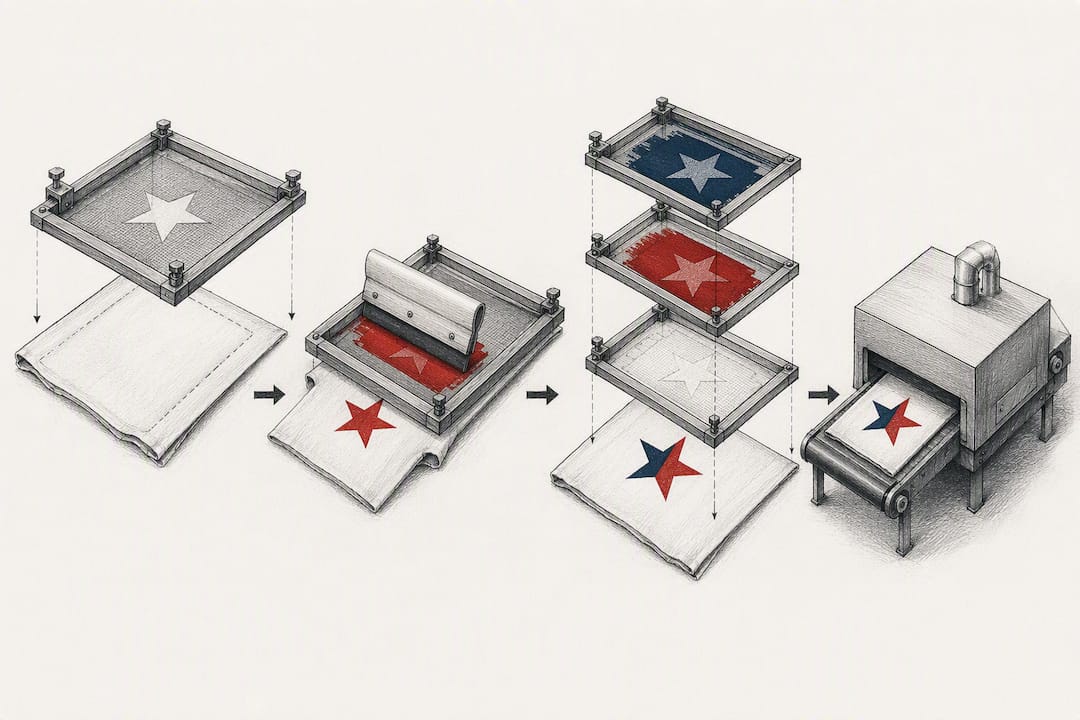
That per-color setup cost is also screen printing’s biggest strength once you understand the tradeoff. Because screens are burned once and then reused for the entire run, the cost per shirt drops sharply as quantity climbs. Automatic press systems with multiple print stations can push through hundreds of shirts an hour once screens are locked in, which is where screen printing pulls dramatically ahead of DTG on large orders.
Screen printing also opens the door to effects DTG simply cannot replicate:
- Specialty inks like discharge, metallic, puff, and foil are available in screen printing and give brand and retail designs a tactile, premium feel, according to EXILE Technologies.
- Ink sits on top of the fabric fibers rather than absorbing into them, which is part of why properly cured screen prints tend to outlast DTG prints in long-term wash testing, per Wikipedia’s overview of direct-to-garment printing.
- Screen printing works across a much wider range of fabrics, including blends, performance polyester, and technical textiles that give DTG trouble.
- The tradeoff: complex, photorealistic art with more than 6 or so colors gets expensive fast, since Kornit’s comparison notes screen printing is best suited to bold, limited-color designs rather than gradients.
Which Method Wins on Quality, Durability, Cost, and Turnaround?
Neither method wins across the board, and that’s the point. Each one dominates a different column on the spec sheet, and knowing which columns matter for your order is the whole decision.
| Factor | DTG | Screen Printing |
|---|---|---|
| Best for | Photorealistic art, gradients, one-offs, small runs | Bold spot-color designs, large runs, specialty effects |
| Cost & setup | No setup fee, higher per-shirt cost | Setup fee per color, cheaper per shirt at scale |
| Print quality | Unlimited colors, photo detail | Vibrant solids, limited to a handful of colors |
| Durability | Dozens of wash cycles typical | Can outlast DTG when cured properly |
| Fabric compatibility | Best on high-cotton garments | Works across cotton, blends, and technical fabrics |
| Turnaround | Fast for single pieces | Fast per unit once screens are set |
Print quality and color handling. DTG is, according to Kornit, the superior method for complex, photorealistic designs with unlimited colors and smooth gradients, while screen printing is the better tool for bold, simple designs built on a limited palette, typically one to six solid colors. A band poster with a photo of the lead singer belongs on a DTG press. A logo in two flat colors belongs on a screen press.
Durability and washfastness. This is where a lot of buyers get surprised. DTG prints commonly hold up for dozens of wash cycles, but Wikipedia’s technical entry on direct-to-garment printing notes that high-quality plastisol screen prints often outperform DTG in long-term durability testing, since the ink sits as a distinct layer on top of the fibers rather than absorbing into them. Cure temperature matters enormously for both methods. An under-cured DTG print or a screen print that never fully hit its cure temperature will crack and fade regardless of which technology produced it.
Cost and run-size economics. Setup is the entire story here. DTG has no meaningful setup cost, so a single shirt costs roughly the same per unit as shirt number ten. Screen printing charges a setup fee per color, which gets amortized across the run, meaning a 200-shirt order with two colors ends up far cheaper per shirt than the same order run through DTG. Shopify’s comparison puts the practical crossover around two dozen shirts: below that, DTG usually wins on total cost; above it, screen printing typically pulls ahead, with the exact number shifting based on color count and whether dark-garment pretreatment is involved.
Fabric suitability. DTG wants 100% cotton or high-cotton blends with a tight weave. Screen printing tolerates a much wider range, including poly-blend athletic wear and technical fabrics that would resist DTG ink absorption entirely.
Turnaround. For a single sample or a rush order of a dozen shirts, DTG is faster because there’s no screen-burning step to wait on. Once a screen printer has burned screens for a job, though, output per hour on an automatic press outpaces DTG by a wide margin, which flips the turnaround advantage on anything beyond a small batch.
Sustainability. DTG generally produces less water and chemical waste than traditional screen printing, largely because it uses water-based, non-toxic inks and skips the screen-cleaning step that consumes water and solvent in a traditional shop. That said, Kornit also notes that modern industrial DTG systems and updated screen-printing techniques using water-based inks have narrowed that gap considerably over the past several years.
What Should You Budget for Screen Print vs DTG Orders?
Run size drives price more than any other variable in this decision, and the math is simple once you see the pattern laid out. Small orders carry DTG’s advantage because there’s nothing to amortize. Large orders flip the math because screen printing’s setup cost gets divided across more shirts.
Think of pricing in three loose bands, understanding that exact numbers vary by shop, garment, and design:
- Small runs (1 to roughly 24 shirts): DTG usually wins on total cost since there’s no per-color setup fee to spread across so few units.
- Mid-range runs (around 25 to 100 shirts): This is the crossover zone. Screen printing starts pulling ahead, especially with one or two colors, but a highly detailed, multi-color design can still favor DTG here.
- Large runs (100+ shirts): Screen printing typically wins decisively, since the per-color setup cost gets spread thin and automatic presses churn through volume fast.
Two variables move that crossover point in either direction. More colors in your design raise screen printing’s setup cost proportionally, which pushes the crossover toward a higher shirt count. Dark garments requiring pretreatment add cost to DTG on a per-shirt basis, which can pull the crossover down.
Before requesting quotes from any printer, gather these details so you get an accurate comparison:
- Garment type and fabric content (cotton, blend, or technical fabric)
- Number of colors in the design and whether it includes gradients or photo elements
- Print area size and placement (front, back, sleeve)
- Whether the base garment is light or dark-colored
- Total quantity needed, plus whether you expect to reorder
Which Fabrics Work Best with Each Printing Method?
Fabric choice is the most common reason a print order disappoints, and it’s rarely the printer’s fault. DTG performs best on 100% ringspun cotton with a tight, even weave, since the ink needs fiber to absorb into. Higher polyester content complicates that absorption and can leave colors looking washed out unless the shop uses specific ink formulations built for blends, according to Shopify.
Screen printing is far more forgiving on fabric choice. It handles cotton, poly blends, and technical athletic fabrics without much fuss, largely because the ink sits on the surface rather than needing to soak in.
Dark garments need pretreatment regardless of method, though the process looks different for each. DTG requires a pretreatment spray and a pre-cure pass before the white underbase goes down, adding a small cost and a few minutes to each piece. Screen printing handles dark fabric by printing a white ink layer as its own screen pass, then flashing it before adding color on top.
A few tips that extend the life of either print type: choose heavier-weight cotton for anything getting washed often, avoid fabric softener (it breaks down ink bonds over time), and turn printed garments inside out before machine washing.
Is DTG or Screen Printing Better for the Environment?
DTG generally produces less water and chemical waste than traditional screen printing. Water-based DTG inks and the absence of a screen-cleaning step mean lower solvent use overall, according to Kornit. Traditional screen printing has historically used more water and chemicals, mostly from cleaning screens between color changes and jobs, though shops that have switched to water-based screen inks have closed much of that gap in recent years.
If sustainability matters to your order, ask any printer three direct questions: what type of ink they use (water-based versus plastisol), how they handle wastewater from screen cleaning, and whether their curing equipment runs on standard or high-efficiency energy settings.
Pro Tip: Ask to see a cured sample stretched and washed before committing to a large order. A shop confident in its process will have one on hand without hesitation.
How Do You Decide Between DTG and Screen Printing for Your Order?
Work through this checklist before you request a single quote:
- Count your quantity. Fewer than roughly two dozen pieces points toward DTG; more points toward screen printing.
- Assess your artwork. Photos, gradients, or more than six colors favor DTG; bold, flat, limited-color logos favor screen printing.
- Check your fabric. High-cotton content works for either method; blends and technical fabrics lean screen printing.
- Weigh durability needs. Uniforms and retail merchandise that need to survive years of washing lean screen printing; event shirts worn a handful of times can go either way.
- Factor in specialty finishes. Puff, metallic, or discharge ink only comes from a screen press.
- Confirm turnaround. Need it tomorrow in low quantity? DTG. Need 500 units in three weeks? Screen printing, once screens are burned.
A few real-world scenarios where this plays out: a band merch drop with a photorealistic album cover and an order of 15 shirts is a clear DTG job. A company picnic ordering 150 shirts in one logo color is a clear screen-printing job. A product prototype you need to see in hand before committing to a bulk order should always go through DTG first, then move to screen printing once the design is locked. A retail apparel line launching multiple SKUs at moderate volume often benefits from doing both, sampling in DTG and producing the winners in screen print.
Pro Tip: If a printer can’t explain their pretreatment process or won’t tell you their cure temperature and time, treat that as a red flag; both are the difference between a shirt that lasts and one that cracks after three washes.
What Gulf of America’s Track Record Tells You About Buying Confidence
This veteran-owned brand backs every order with a 30-day money-back guarantee and has a large number of positive customer reviews. Those aren’t printing credentials, they’re purchase-confidence signals, and for anyone weighing custom apparel decisions, that distinction matters.
Here’s what that actually means if you’re buying:
- A 30-day guarantee means you’re not stuck with a product that doesn’t fit or doesn’t meet expectations, which matters more with apparel than almost any other product category.
- A veteran-owned operation with thousands of reviews has a track record of standing behind quality, not just claiming it.
- Responsive customer service on a purchase this personal, something with your values on your chest, isn’t optional.
If you’d rather skip the custom-printing decision entirely, there are companies that sell ready-made patriotic hats and apparel, already produced, quality-checked, and ready to ship. That’s a legitimate alternative to commissioning a custom print run when you want something dependable without managing color counts and vendor quotes yourself.
A Shop-Floor Take: Stop Picking One Method Forever
The biggest mistake I see is treating this like a permanent choice, DTG shop or screen-print shop, pick a side. It’s not. The smartest operators run both, because the job dictates the method, not the other way around.
DTG earns its keep on samples, prototypes, and any run under a couple dozen units where photographic detail matters. Screen printing earns its keep the moment you’re locking in a stable design for a real production run, especially anything wearing a specialty ink or living on a technical fabric. If you’re vetting a vendor, ask to see both a DTG sample and a screen-printed sample stretched, and ask how each was cured. A shop that can answer both questions confidently understands the tradeoffs well enough to steer you right. For a deeper technical breakdown of transfer-based alternatives, Shay’s Print Shop’s comparison of DTG and DTF is worth a look if you’re weighing a third option.
— Erik
Prefer Ready-Made Patriotic Gear Over Managing a Print Order?
Not every buyer wants to manage color counts, pretreatment questions, and vendor quotes. One option for readers who want quality patriotic apparel without commissioning a custom print run is a veteran-owned brand with a 30-day money-back guarantee and a strong record of positive customer reviews.

Two ready-to-ship options worth a look: the embroidered patch mesh back trucker hat and the patriotic snapback trucker hat, both built from premium materials and backed by a money-back guarantee. If your project actually calls for custom printing, whether DTG or screen print, reach out to a local decorator or print provider who can quote your specific design and quantity. But if what you want is finished, dependable patriotic gear today, browse the full Gulf of America lineup and place your order.
Sources
- DTG Printing vs Screen Printing: How to Choose the Right Method — Kornit Digital
- Screen Printing vs DTG Printing: How to Choose the Right Method — Printable Press
- DTG vs Screen Printing: How to Choose — Shopify blog
FAQ
What lasts longer, screen printing or DTG?
Properly cured screen prints often outlast DTG prints in long-term wash testing, since the ink sits as a raised layer on the fabric rather than absorbing into the fibers. DTG prints typically hold up well for dozens of wash cycles, but cure quality matters more than the method itself.
What are the disadvantages of DTG printing?
DTG struggles with high-polyester blends, requires pretreatment on dark garments, and gets more expensive per shirt as quantity increases since there’s no setup cost to amortize across a large run. Equipment maintenance, especially print head clogs and white ink management, also creates hidden costs for shops.
How can you tell DTG from screen printing on a finished shirt?
DTG prints tend to feel soft and blend into the fabric since the ink absorbs into the fibers, while screen prints have a slightly raised, more textured feel because the ink sits on top. Photographic detail and smooth gradients almost always indicate DTG, while flat, bold spot colors usually point to screen printing.
Is DTG or screen printing more expensive?
It depends entirely on quantity. DTG is typically cheaper for small orders under roughly two dozen shirts since there’s no setup fee, while screen printing becomes cheaper per unit above that threshold because its per-color setup cost gets spread across more pieces.