

Six Days the U.S. Requires the POW/MIA Flag to Fly and Why It Matters
The POW/MIA flag is the nation’s symbol of concern and commitment to accounting for U.S. prisoners of war and service members missing in action, captured in one line: “You Are Not Forgotten.” The National League of POW/MIA Families created it, Congress recognized it by law, and federal sites are now required to fly it on specific days each year.
TL;DR:
- The POW/MIA flag was designed in 1972 by a veteran and became a federal symbol through laws passed in 1990, 1998, and 2019.
- Its black and white design features a silhouette of a bowed head, barbed wire, and a guard tower, symbolizing captivity and mourning.
- The flag is mandated to be displayed on six specific federal days and is often flown daily at VA and military sites beyond legal requirements.
- The flag does not imply prisoners are still alive but serves as a ongoing pledge to account for missing service members.
- Due to its non-trademarked status, many unofficial versions exist, reflecting its broad public and organizational use.
Table of Contents
- What Does the POW/MIA Flag Mean and Where Did It Come From?
- What Do the Flag’s Design Elements Symbolize?
- When and How Must the POW/MIA Flag Be Displayed?
- Why Do People Still Fly the POW/MIA Flag Today?
- Does the POW/MIA Flag Mean Prisoners Are Still Alive?
- A Publisher’s Note on Honoring This Symbol
- Wear the Symbol With the Respect It Deserves
- Where to Learn More
- Sources
What Does the POW/MIA Flag Mean and Where Did It Come From?
The flag exists because one woman refused to let the government forget about missing service members. Mary Hoff, whose husband Michael Hoff was a Navy pilot missing in action in Laos, pushed for a national symbol in 1971. She worked with Annin & Company, the flag manufacturer, and commercial artist Newt Heisley to design it. Heisley, a World War II pilot himself, produced the black-and-white silhouette design that debuted in 1972.
The flag moved from a grassroots symbol to federal law over three decades:
- 1982: The flag flew over the White House for the first time, an unusual honor for a non-national flag.
- 1990: Congress passed Public Law 101-355, formally recognizing the flag as the symbol of concern for POWs and MIAs.
- 1998: The Defense Authorization Act required its display at certain federal properties on designated days.
- 2019: The National POW/MIA Flag Act expanded that mandate, requiring the flag alongside the U.S. flag at prominent federal sites whenever the U.S. flag flies.
The National League of Families still stewards the flag today. The organization never trademarked it, a deliberate choice meant to spread the symbol as widely as possible rather than control its use, according to the League’s own history. That decision explains why you now see it outside city halls, VFW posts, and small-town diners, not just federal buildings.
What Do the Flag’s Design Elements Symbolize?
Every part of the design carries a deliberate message. The silhouette of a man’s bowed head is often described as based on Heisley’s own son, Jeffrey, who was preparing to deploy at the time his father sketched the design; the story has become part of the flag’s lore even though it’s difficult to verify with certainty.
Behind the figure sits a guard tower, and below it runs a strand of barbed wire, both direct references to captivity and the harsh conditions POWs endured. The circular emblem carries the letters “POW” and “MIA,” short for prisoner of war and missing in action, so the flag speaks to two related but distinct categories of loss. Beneath it all runs the motto that gives the flag its emotional weight: “You Are Not Forgotten.”
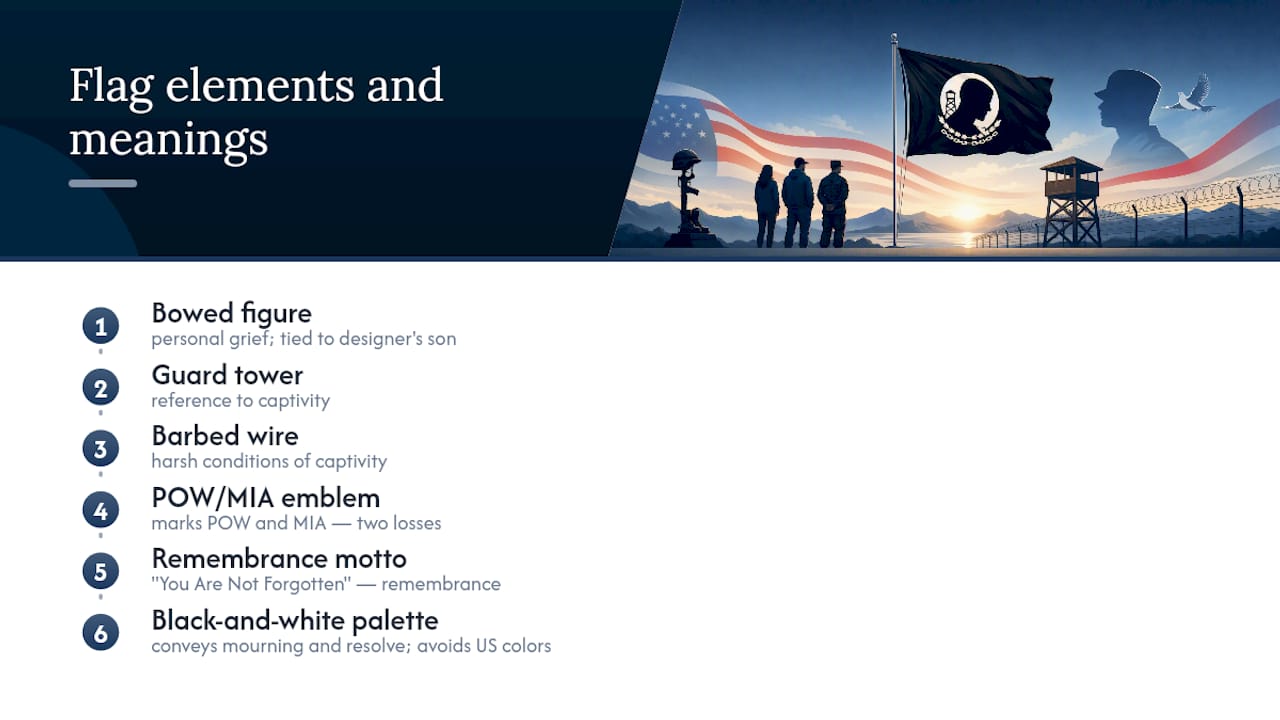
The palette matters too. Heisley chose black and white intentionally, avoiding red, white, and blue so the flag would never be confused with the American flag or read as celebratory. The stark contrast was meant to convey mourning and resolve, not patriotism in the traditional sense.
One flag, zero rivals: according to Time’s history of the design, the POW/MIA flag is the only non-national flag the federal government mandates flying at specified sites, a distinction no other advocacy symbol in American history holds.
When and How Must the POW/MIA Flag Be Displayed?
Federal law is specific about this flag, more specific than most people realize. Public Law 101-355, combined with the 1998 Defense Authorization Act and the 2019 National POW/MIA Flag Act, requires display at places like the White House, the U.S. Capitol, major military installations, and all VA medical centers.
Six days trigger mandatory display at those federal sites:
- Armed Forces Day
- Memorial Day
- Flag Day
- Independence Day
- National POW/MIA Recognition Day (the third Friday in September)
- Veterans Day
Placement follows flag etiquette rules that predate this specific law but still apply:
- On a single staff, the POW/MIA flag flies directly below the U.S. flag.
- On adjacent staffs, the U.S. flag takes the position of honor to the viewer’s left, with the POW/MIA flag to the right.
- The flag should never fly higher than or in place of the U.S. flag.
Beyond the mandated dates, VA facilities commonly fly the flag every day as standard practice, not because law requires it but because the agency treats remembrance as ongoing rather than occasional.
Why Do People Still Fly the POW/MIA Flag Today?
You’ll spot the flag well beyond federal property. Post offices, veterans’ halls, American Legion posts, police and fire stations, and countless private homes fly it year round, a spread that outpaces what any single law requires.
The flag shows up most visibly during ceremonial moments:
- National POW/MIA Recognition Day observances, which often include roll calls of the missing by name.
- Missing-man table ceremonies, where a single empty chair, an inverted glass, and a folded flag represent those who never came home.
- Veterans Day and Memorial Day parades, where color guards carry it alongside the U.S. flag.
The deeper purpose hasn’t changed since 1972. The flag represents an active government commitment, not a closed chapter, to keep accounting for missing personnel from past conflicts.
Pro Tip: If you’re organizing a civic event or ceremony, pair the flag with a brief roll call or moment of silence rather than just a visual display. The symbolism lands harder when it’s tied to a specific act of remembrance, not just decor.
Does the POW/MIA Flag Mean Prisoners Are Still Alive?
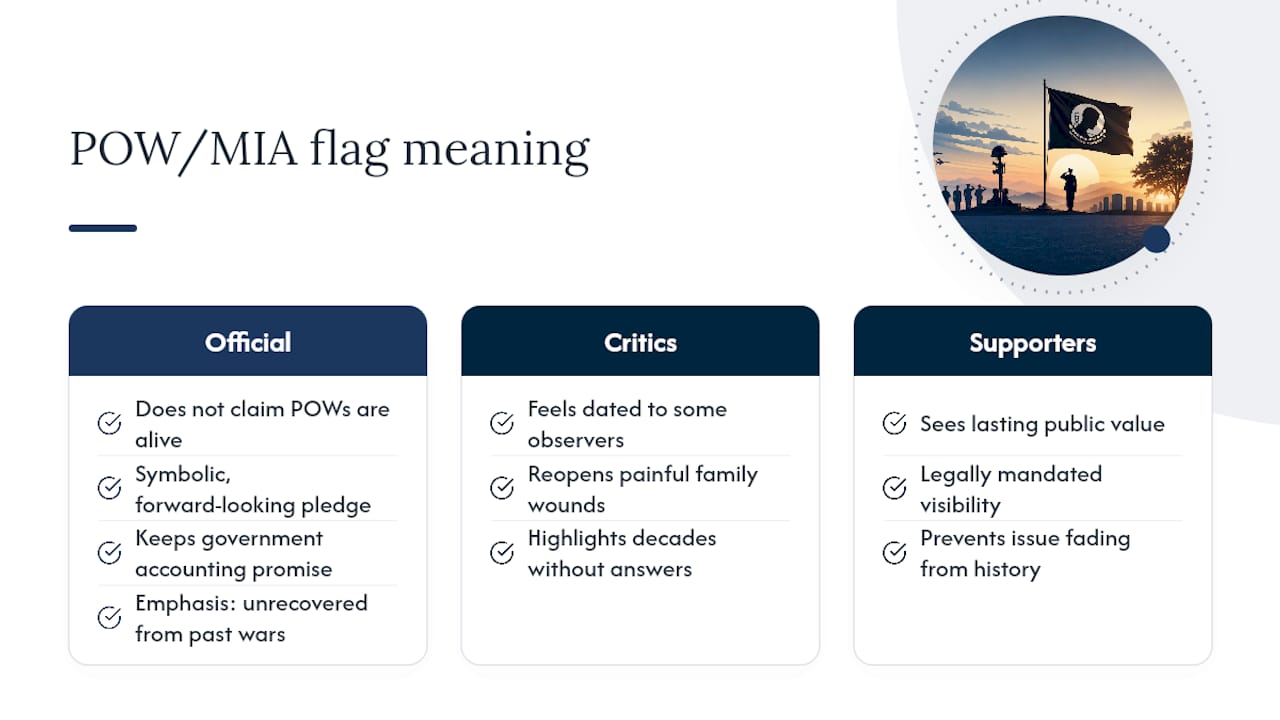
No. The flag does not claim that American POWs remain alive in captivity today. Its purpose is symbolic and forward looking: a standing pledge that the government won’t stop trying to account for those still unrecovered from past conflicts, particularly Vietnam.
Some critics argue the flag feels dated or reopens painful wounds for families who’ve waited decades without answers. Others see permanent value in a visible, legally mandated symbol that keeps the issue from fading into history.
One more wrinkle: because the League never trademarked the design, it entered the public domain. That’s produced dozens of unofficial color schemes and layout tweaks over the years, so the flag you see at one veterans’ hall may look slightly different from the one flying at another.
A Publisher’s Note on Honoring This Symbol
Erik has spent years writing about veteran causes and the symbols that carry real weight in American civic life, and few carry more than this one. What strikes him most is how deliberately restrained the design is: no color, no flourish, just a silhouette and a promise.
Gulf of America was built by veterans who understand that patriotic apparel only means something if it’s made with the same restraint and respect the flag itself demands. That philosophy shapes every product in the next section.
— Erik
Wear the Symbol With the Respect It Deserves
Gulf of America gives you a veteran-owned alternative to mass-market patriotic gear that treats these symbols as decoration first and meaning second. Every product ships with the same 30-day money-back guarantee and the durability of premium materials, backed by over 2,400 positive customer reviews from shoppers who wanted apparel that actually holds up.

If you’re looking for a tasteful way to show support without leaning on overtly political imagery, the Gulf of America Hat Embroidered Patch Mesh Back Trucker Hat offers a clean, embroidered design built for daily wear. For readers who prefer a classic silhouette, the Gulf of America Trucker Hat, Patriotic Snapback Baseball Cap delivers the same craftsmanship in a familiar snapback shape. And if you want something a little more relaxed for warm-weather wear, the Gulf of America Sunset Palm Trees Men’s Embroidered Mesh Back Trucker Hat pairs American pride with a coastal look, without touching political territory at all.
Browse the full Gulf of America hat collection and pick the style that fits how you want to show up for Memorial Day, Veterans Day, or any day you want to fly your colors.
Where to Learn More
- U.S. Department of Veterans Affairs: origin, symbolism, and federal display law.
- National League of POW/MIA Families: flag history and reproduction guidance.
- National POW/MIA Memorial & Museum: design history and congressional recognition.
- Congress: full text of the 2019 National POW/MIA Flag Act.
- Time: historical context on the flag’s federal prominence.