

4.5°C Cooler: Moisture Wicking Cotton That Outperforms Synthetics
Moisture-wicking cotton is cotton that’s been engineered or finished to pull sweat away from your skin and spread it out so it evaporates faster than untreated cotton allows. In mild conditions, some of these treatments have been shown to drop surface temperature by up to 4.5°C compared to regular cotton. For everyday wear, commutes, and moderate workouts, treated cotton holds its own against synthetics. For all-day heavy sweating or wet-cold exposure, it still has real limits.
TL;DR:
- Treated cotton can dry as quickly as polyester in moderate conditions but remains less effective during sustained heavy sweating or wet-cold outdoor activity.
- Fabric finishes like TransDRY® and WICKING WINDOWS™ improve moisture management by reducing water absorption and directing sweat outward for faster evaporation.
- New durable, fluorine-free finishes bond at the fiber level, maintaining performance after many washes and reducing environmental impact.
- Regular cotton gets heavy and slow to dry when wet, while synthetic fibers excel at high-output moisture transport without absorption.
- Match treated cotton to casual wear, short workouts, or daily commuting, but prefer synthetics or layered systems for extended heavy sweating or safety-critical outdoor use.
Table of Contents
- How Moisture-Wicking Cotton Actually Moves Sweat
- Treated Cotton vs. Regular Cotton vs. Synthetic Fabric
- The Technologies Behind the Claims (And What the Testing Shows)
- When Moisture-Wicking Cotton Is (and Isn’t) the Right Call
- Keeping the Wicking Finish Alive Through the Wash
- Why This Matters More Than the Marketing Suggests
- Breathable Headwear Built With Comfort in Mind
- Sources
- FAQ
How Moisture-Wicking Cotton Actually Moves Sweat
Regular cotton soaks up water like a sponge and holds onto it. Every fiber absorbs moisture more or less evenly, which is exactly why a cotton shirt feels heavy and clammy after a hard walk. Engineered cotton breaks that pattern by building in directional pathways, so sweat has somewhere specific to go.
The core mechanism is capillary action. Tiny gaps between fibers and yarns act like straws, pulling liquid along the channels created during weaving or finishing. Fabric engineers control how tight those channels are and where they point, which determines whether moisture travels sideways, outward, or gets stuck.
The more advanced trick is asymmetric wettability, sometimes called Janus construction after the two-faced Roman god. One side of the fabric is treated to repel water, the other to absorb and spread it, so moisture only moves in one direction: away from your skin, toward the outer surface where air can reach it. Electrospraying techniques can build this asymmetry into cotton at a large scale rather than just in small lab batches.
A few things shift depending on how a fabric is built:
- Yarn blends that mix untreated and hydrophobic-treated cotton fibers change how fast liquid spreads.
- Printed repellent zones on the inner layer create dry “windows” instead of treating the whole garment.
- Tighter weaves slow drying even with a good finish, since airflow through the fabric matters as much as the chemistry.
Wicking and absorption aren’t the same job. Absorption holds water. Wicking moves it and spreads it across a wider surface area, which speeds up evaporation. That’s the whole point of the technology: less water sitting in one place, more surface exposed to air.
Treated Cotton vs. Regular Cotton vs. Synthetic Fabric
Untreated cotton is comfortable against the skin, but it’s also a poor performer once sweat shows up. It absorbs a lot of moisture, gets noticeably heavier, and dries slowly because that water is trapped inside the fiber itself rather than sitting on the surface where air can pull it away.
Treated cotton changes the equation without changing the fiber you’re wearing. The finish reduces how much water the fabric holds onto and creates channels that move it outward, and Cotton Incorporated’s research shows this can let treated cotton dry as fast as, or faster than, many synthetic fabrics under normal conditions.
Synthetic fibers like polyester start from a different baseline. They’re inherently hydrophobic, meaning they don’t absorb water at all. Instead, they push moisture along the fiber surface to be evaporated off. A polyester performance fabric built for youth sports demonstrates this approach: no absorption to slow it down, just surface transport.
Here’s how the three compare in practice:
- Regular cotton: absorbs heavily, gets heavy when wet, dries slowly.
- Treated cotton: limited absorption, built-in transport channels, dries close to synthetic speed in everyday use.
- Synthetics: no absorption at all, consistent performance in high-output or extreme-wet conditions.
If you’re dealing with light-to-moderate sweat, treated cotton is a fine call. If you’re facing sustained heavy output or wet-cold exposure where staying dry is a safety issue, synthetics or a layered system still have the edge.
The Technologies Behind the Claims (And What the Testing Shows)
Two names show up constantly on cotton performance apparel tags, and both come out of Cotton Incorporated’s fabric research. TransDRY® reduces cotton’s natural absorbency and builds in directional channels that carry sweat outward, letting the fabric dry faster without losing that soft cotton hand-feel. WICKING WINDOWS™ takes a more targeted approach, printing repellent finish onto the skin-facing side while leaving small absorbent “windows” open, so moisture gets pushed toward specific exit points instead of spreading evenly.
A concrete number worth knowing: in laboratory testing, cotton fabric treated with a two-step grafting finish improved its liquid moisture management score from about 2.5 to 4.0 on a 5-point scale, a meaningful jump in a standardized industry test rather than a marketing estimate.
Separate peer-reviewed testing on Janus-style asymmetric cotton found:
- Temperature reduction of up to 4.5°C in mild conditions
- About 3.5°C reduction in high-heat, high-humidity environments where wicking usually matters most
Durability used to be the catch. Older topical coatings wore off after a handful of washes. Newer finishes solve this by bonding the hydrophobic treatment directly to the fiber at a molecular level, and many of the newest versions skip fluorinated chemicals entirely, which addresses both the durability complaint and the environmental one.
When you’re reading a product tag, look for a named finish or test method (a liquid moisture management score, a specific technology name) rather than a vague “quick-dry” claim with no backing.
When Moisture-Wicking Cotton Is (and Isn’t) the Right Call
Treated cotton earns its keep in specific situations and falls short in others. Match it to what you’re actually doing:
- Daily commuting and travel. Light, intermittent sweat is exactly what wicking finishes handle well.
- Casual activewear and errands. You get cotton’s comfort with a real drying-speed upgrade.
- Low-to-moderate exercise. Walking, light cycling, and gym sessions under an hour stay in treated cotton’s comfort zone.
- Sustained heavy sweating. Long runs, hot-weather labor, or back-to-back training sessions push past what most cotton finishes can keep up with.
- Wet-cold outdoor activity. When staying dry is a safety issue, not just a comfort one, favor synthetic base layers or a proper layering system instead.
A looser fit reduces wet-cling regardless of fabric, and pairing treated cotton with a breathable outer layer covers you if conditions turn. Before buying, check the product page for the actual finish name, the cotton blend percentage, and the recommended wash cycle. Vague comfort language without those details is a red flag.
Keeping the Wicking Finish Alive Through the Wash
Moisture-wicking finishes degrade with the wrong laundry habits, not just age. A few adjustments extend their life considerably.
- Wash in cool or warm water, never hot, and skip fabric softener entirely since it coats fibers and blocks the wicking channels.
- Avoid chlorine bleach, which breaks down the bonded finish faster than normal wear does.
- Tumble dry on low heat, or air dry, since high heat accelerates finish breakdown over repeated cycles.
- Watch for slower drying times after 30 to 40 washes. That’s usually the first sign the treatment is fading.
Pro Tip: Test wicking at home with a simple towel blot. Press a damp cloth against the fabric, then time how long it takes to dry compared to a plain cotton tee. If the gap has closed noticeably since you bought it, the finish is wearing thin.
Why This Matters More Than the Marketing Suggests
Most apparel copy treats “moisture-wicking” as a single feature, like a zipper or a pocket. It isn’t. It’s a spectrum, and where a garment sits on that spectrum depends on the specific finish, how it was applied, and how many wash cycles it’s survived. A shirt with a bonded, fluorine-free finish behaves nothing like one with a cheap topical spray that washes out in a month, even if both tags say the same thing.
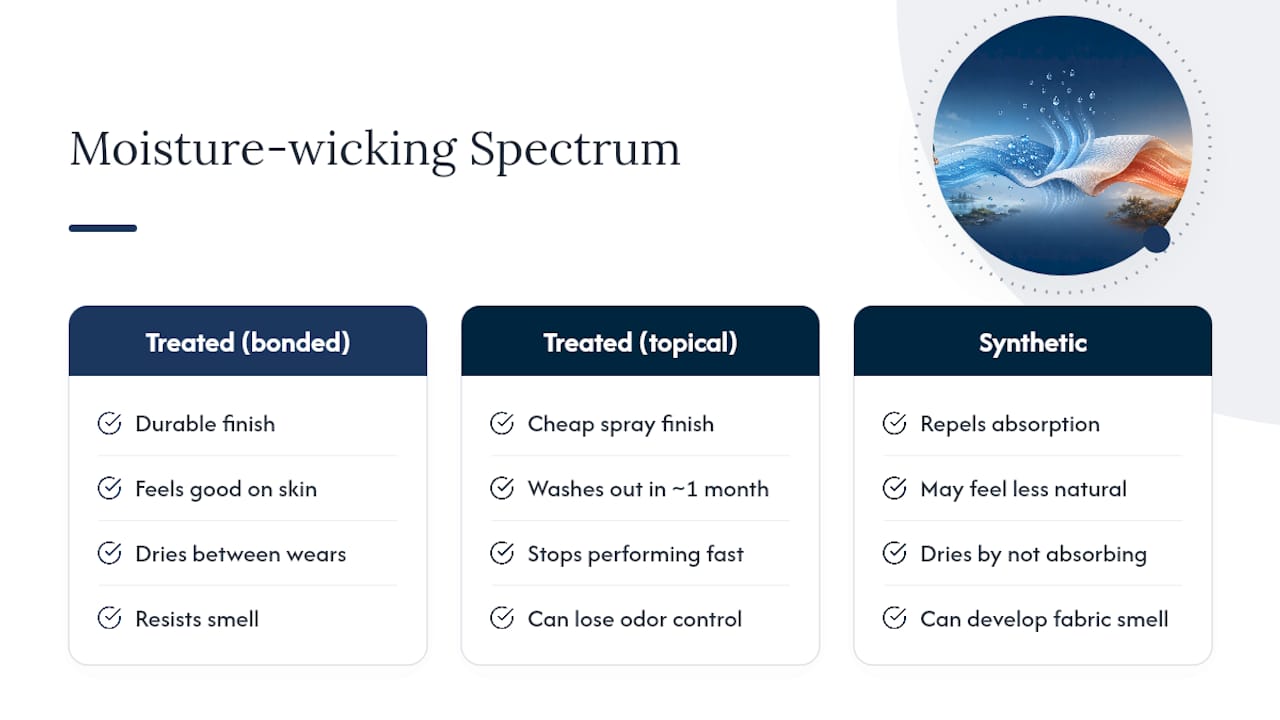
The bigger misconception I keep running into is the idea that synthetics are automatically the “real” performance choice and treated cotton is a compromise. The lab numbers don’t support that hierarchy for everyday use. A commuter or a casual gym-goer doesn’t need fiber that never absorbs a drop of water. They need something that dries fast enough between now and dinner, feels good against skin all day, and doesn’t develop the synthetic-fabric smell after one wear. That’s the gap treated cotton fills, and it’s the reason Gulf of America builds mesh-back and breathable-weave elements into its headwear: comfort-first materials that still respect how heat and moisture actually move.
Where I’d push back on the industry itself is durability transparency. Too many product pages lean on the words “moisture-wicking” without naming the finish or citing a test standard. If a brand doesn’t tell you the technology behind the claim, treat the claim as unproven.
— Erik
Breathable Headwear Built With Comfort in Mind
The company backs every order with a 30-day money-back guarantee and has built up many positive reviews from customers who care about both quality and mission. That combination matters if you’re shopping for headwear designed for comfort in heat, sweat, and wear.

Many trucker hats use mesh-back construction for airflow: ventilation at the back panel keeps heat from building up under the crown, which matters more on a hot day than the front panel’s fabric. The Embroidered Patch Mesh Back Trucker Hat and the Leather Patch Trucker Hat with mesh back both use this design. So does the Patriotic Snapback Baseball Cap, the 2025 Mesh Back Trucker Hat, and the Waves Retro Trucker Hat. Browse the full hat collection and order with the 30-day guarantee backing your choice.
Sources
- Janus cotton with unidirectional-wicking, tri-mold cooling and antibacterial performance for personal thermal-moisture management
- Moisture‑management cotton fabric by two-step grafting and finishing (Journal article DOI)
- Review of fluorine-free durable hydrophobic textile finishes (PMC review)
- TransDRY® Technology Moisture Wicking - Cotton Incorporated
FAQ
Which Fabric Wicks Moisture the Best?
Pure synthetic fibers like polyester wick moisture most consistently because they don’t absorb water at all, but treated cotton with a technology like TransDRY® can match that performance in everyday, moderate-activity conditions.
What’s the Difference Between Dri-Fit and Moisture-Wicking?
“Dri-fit” is a brand-specific name for a synthetic moisture-wicking fabric, while “moisture-wicking” is the general term covering any fabric, cotton or synthetic, engineered to move sweat away from skin.
Is Polyester or Cotton Better for Wicking Moisture?
Untreated cotton absorbs and holds moisture, making it slower to dry, while polyester repels water from the fiber itself; treated cotton narrows that gap significantly for light-to-moderate sweating.
What’s the Difference Between Moisture-Wicking and Breathable Fabric?
Moisture-wicking describes how a fabric moves liquid sweat away from skin, while breathable describes how well air and vapor pass through the material. A fabric can do one well without doing the other, which is why mesh panels on hats target breathability specifically.