

5 Flat T Shirt Measurements: Chest First, Then Match Product Pages
The fastest reliable way to get the right t-shirt size is to measure a tee you already own and like, laid flat, and use the chest measurement as your primary comparator. Chest width predicts fit better than any other number on the tag. Once you have that figure, compare it against the brand’s chart in the same format (flat or circumference) rather than trusting the letter size alone.
TL;DR:
- Measuring a favorite, well-fitting shirt flat and doubling the pit-to-pit chest measurement provides the most accurate size comparison.
- Ensuring measurements are taken on a hard, flat surface with smooth fabric reduces errors that can cause sizing discrepancies.
- Double-check measurements and compare against brand-specific size charts that specify flat widths versus full circumferences to avoid common mistakes.
- Fabric composition and fit style significantly impact sizing, with stretch fabrics allowing downsizing and slim fits fitting closer to the body.
- Consulting detailed product pages that list precise measurements helps match your benchmark shirt more reliably before purchasing.
Table of Contents
- What You Need to Measure a T-Shirt Size
- How to Measure Chest, Length, Shoulders, and Sleeves
- Garment Measurements vs Body Measurements: Where People Go Wrong
- How to Read a Size Chart and Match Your Measurements
- Fit Styles and Fabric: How Cut and Material Change Your Size
- Why You Can Trust Gulf of America Product Pages for Sizing Details
- How to Measure Neck Circumference for Collars and Crew Necks
- How to Measure Armhole Size and Neckline Width for a Better Fit
- Tips for Measuring Kids’ T-Shirts vs Adult T-Shirts
- How Body Shape Affects T-Shirt Fit and What Your Measurements Really Mean
- What Most Sizing Guides Get Wrong
- Check Gulf of America’s Product Pages Before You Order
- Sources
- FAQ
What You Need to Measure a T-Shirt Size
You don’t need a sewing kit to do this right. A soft fabric tape measure is the best tool because it curves naturally around seams and lies flat without kinking a ruler would. No tape on hand? A piece of string laid along the garment and then measured against a yardstick works almost as well, though it introduces more room for error on curves like the neckline.
Set up on a flat, hard surface, a table or clean floor beats a bed or couch every time, since a soft surface lets fabric sink and distort the numbers.
- Grab a benchmark tee, ideally one you already wear and like the fit of.
- Smooth out wrinkles and square up the shoulders so the shirt isn’t twisted.
- Fold it exactly in half along the center seam if there is one, keeping both sides even.
- Write down every measurement in inches, and label which shirt it came from.
That last step matters more than people think. A phone note titled “Gray crew neck, size L” saves you from re-measuring the same shirt three months from now when you’re comparing a new purchase.
How to Measure Chest, Length, Shoulders, and Sleeves
This is the flat-garment method, and it’s the same approach Printful recommends for online sellers who need repeatable numbers they can list with confidence. Lay the shirt flat, button or zip it if it has closures, and work through these five measurements in order.
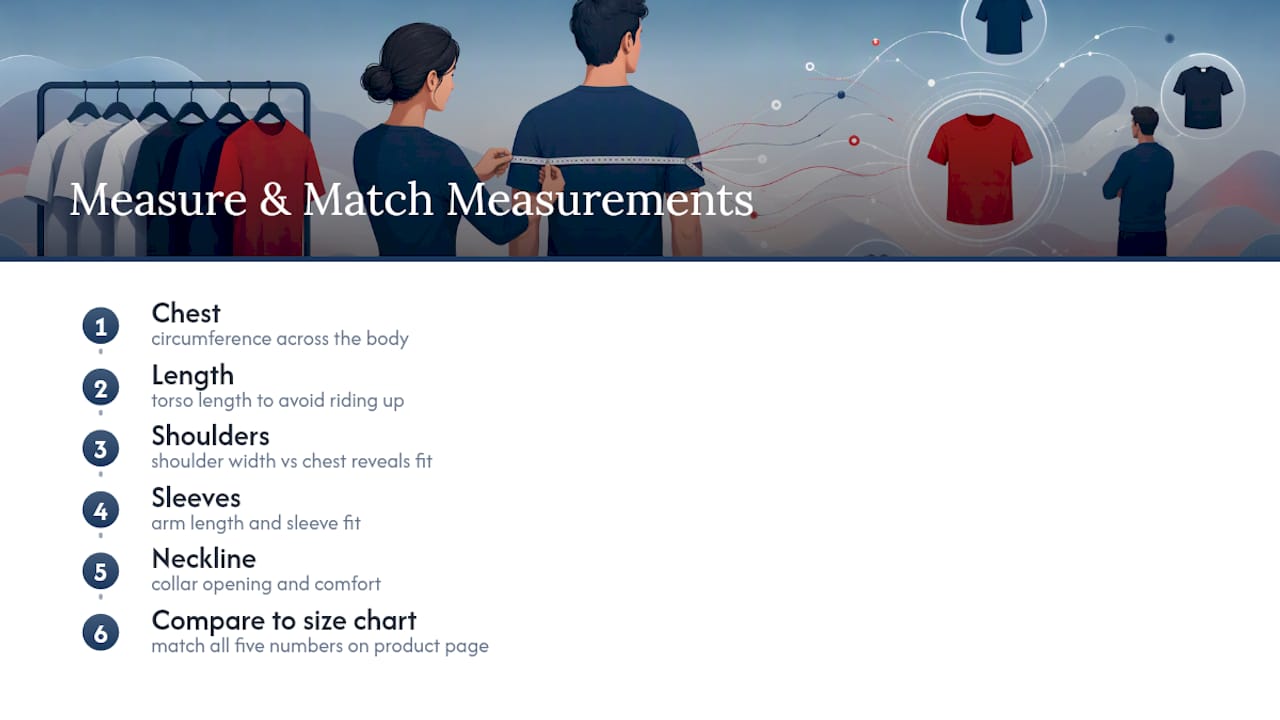
- Chest (pit-to-pit). Lay the tape horizontally from one armpit seam to the other, right where the sleeve meets the body. If there’s a seam, measure about one inch below it to avoid the bulk of the stitching throwing off the number.
- Convert flat chest to body circumference. Double whatever number you got in step one. A flat chest reading of 20 inches means a body circumference of roughly 40 inches. This is the single most misunderstood step in the entire process, and skipping it is why so many people order a shirt that runs small.
- Body length. Measure from the high point of the shoulder, right near the collar seam, straight down to the bottom hem. This number tells you whether a shirt will hit at your hip, sit longer over the waistband, or ride up when you raise your arms.
- Shoulder width. Measure seam to seam across the back, from where one sleeve attaches to where the other does. Prioritize this measurement if you have broader or narrower shoulders than average. It’s the number most likely to make a shirt feel tight across the back even when the chest fits fine.
- Sleeve length. For short sleeves, measure from the shoulder seam to the bottom hem of the sleeve. For long sleeves, measure from that same shoulder seam all the way to the cuff.
Optional but useful: measure the hem width too. If it’s noticeably narrower than the chest measurement, the shirt tapers toward the waist. If it’s close to the same number as the chest, expect a boxier, straight-cut silhouette.
Pro Tip: Measure everything twice. Fabric shifts slightly every time you smooth it out, and a quarter-inch difference on the chest measurement can be the gap between a medium and a large once you double it for body circumference.
Before you write anything down as final, run through a quick verification pass: shirt flat, wrinkles smoothed, tape measure straight (not sagging in the middle), and each number checked a second time. NIST’s own body dimension research for apparel backs up why this consistency matters. Sloppy technique introduces more error than most people realize, especially on curved areas like the neckline and armhole.
Garment Measurements vs Body Measurements: Where People Go Wrong
A flat garment measurement is half the story, literally. When you measure a shirt pit to pit, you’re getting one side of a folded tube of fabric, and that flat width has to be doubled to represent the full circumference of a body wearing it. This is the doubling step from the previous section, and it’s the source of most sizing mistakes online.
Here are the errors that trip people up most often:
- Comparing a flat garment number directly against a chart that lists body circumference, without doubling it first.
- Measuring your own chest over a hoodie or jacket, which adds an inch or two of bulk and skews the reading.
- Rounding a measurement like 19.5 inches up to 20 “to make the math easier,” which compounds once you double it.
- Assuming every brand lists its chart the same way, when some use flat width and others use full circumference on the same page.
If you don’t have a benchmark tee to measure, wrap the tape around the fullest part of your chest, under the arms and across the shoulder blades, keeping it level and snug but not tight. Garment measurement is generally more reliable than body measurement when you’re comparing similar styles from different brands, because it accounts for how that specific cut is constructed rather than your body alone.
How to Read a Size Chart and Match Your Measurements
Look at the header row of any chart before you look at the numbers. Some brands label columns “chest width,” which means a flat measurement; others label them “chest circumference” or “chest (fits up to),” which means the full body measurement. Mixing these up is the single most common reason a listed size chart ends up feeling wrong on arrival.
Once you know which format you’re looking at, match chest first. This measurement drives most of how a shirt feels on your body, according to INTO THE AM’s sizing research, so give it the most weight in your decision. Length and shoulder width matter, but you can tolerate more variance there, generally within an inch, before the fit feels noticeably off.
Fabric with any stretch (even a small percentage of elastane) gives you a little forgiveness on borderline chest measurements. A 100% cotton tee with zero stretch does not, so lean toward sizing up if you’re between two numbers and the fabric is rigid.
Sample chest ranges illustrate why the same letter size varies so much brand to brand. Fruit of the Loom’s size guide lists specific inch ranges for each label, and comparing those ranges against another brand’s chart for the same letter often reveals a two or three inch gap. That’s not inconsistency for its own sake, it reflects different fits, cuts, and target customers, which is exactly why matching inches beats matching letters every time.
Fit Styles and Fabric: How Cut and Material Change Your Size
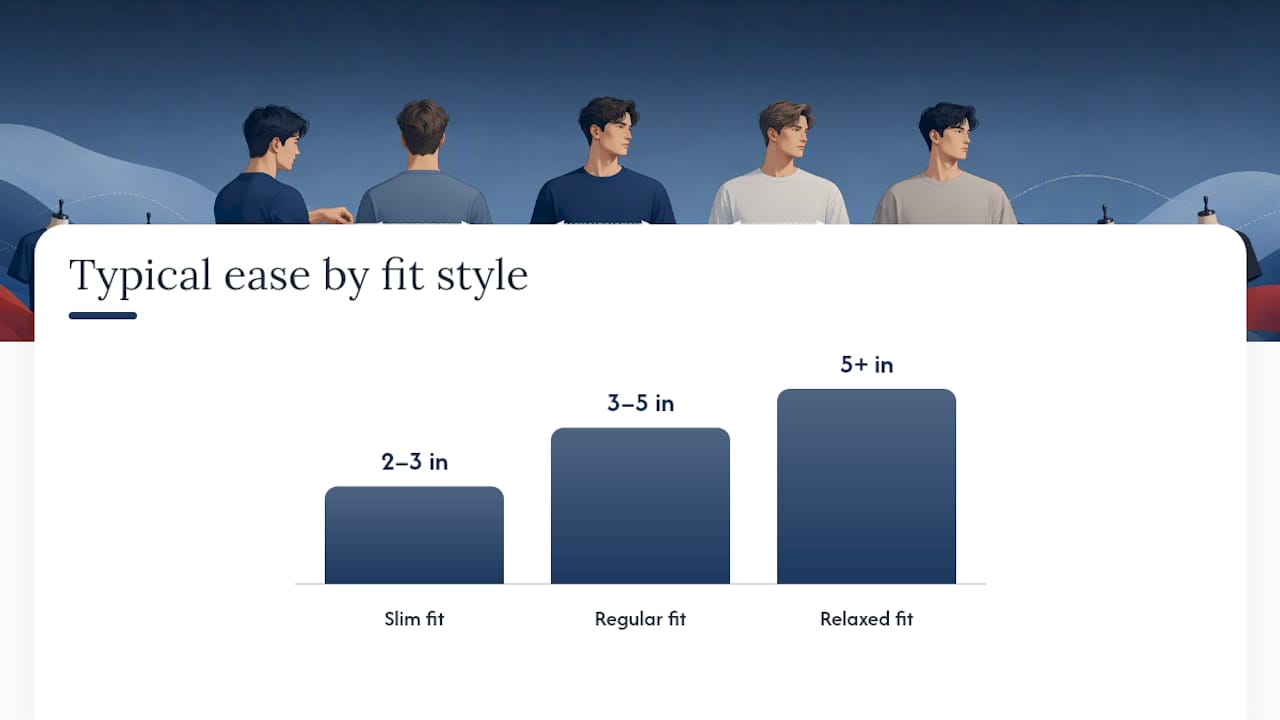
A slim-fit tee and a relaxed-fit tee can share the same chest measurement on the tag and feel completely different on your body. Fit style is the pattern the brand cuts the shirt to, not a separate size category, and it changes how much room you get beyond your actual chest number.
- Slim fit runs close to the body with minimal extra room, often two to three inches of ease beyond your chest measurement.
- Regular fit is the traditional balance, comfortable without being tight, roughly three to five inches of ease.
- Relaxed fit adds more room throughout the body and sleeves, giving you five or more inches of breathing space.
- Oversized intentionally sizes up the entire pattern, sometimes by a full size or more, for a deliberately loose, boxy silhouette.
Fabric composition changes the math again. Cotton blends shrink less predictably than 100% cotton after washing and drying, and cotton alone can lose enough length and width over several washes to shift a shirt into a noticeably smaller feel. Pre-washing a 100% cotton shirt before you judge the fit, or sizing up slightly if you plan to machine dry it on high heat, avoids a lot of buyer’s remorse.
If a shirt has stretch woven in through elastane or spandex, you can usually size down safely from a rigid-cotton equivalent, since the fabric flexes with your body instead of just sitting there. When you’re stuck between two sizes and want a fitted look, size down on stretch fabric and size up on anything 100% cotton with no give.
Why You Can Trust Gulf of America Product Pages for Sizing Details
Gulf of America is a veteran-owned apparel platform built around American heritage themes, and that ownership shapes how the brand writes its product pages. Fit notes, material breakdowns, and garment details are written by people who wear this apparel and stand behind it, not a generic template copied across unrelated categories.
The brand offers a 30-day money-back guarantee, which matters when you’re sizing from a screen instead of a fitting room. If the measurements you took don’t translate the way you expected once the shirt arrives, you have a real window to send it back.
Many positive reviews back up the pattern here: customers consistently report that the fit matches what the product page describes. When you’re checking a Gulf of America listing before you buy, read the fit description alongside any listed chest measurement, and treat that number the same way you’d treat your benchmark tee comparison, matching inches, not just the size label.
How to Measure Neck Circumference for Collars and Crew Necks
Crew necks don’t need a precise neck measurement the way a collared dress shirt does, but the neckline opening still affects comfort and how the shirt sits at rest. Lay the shirt flat and measure straight across the neckline opening from seam to seam, then double that number the same way you doubled the chest, since you’re again only measuring half the circle.
For a shirt with an actual collar, whether it’s a polo-style collar or a button placket, wrap the tape around your own neck at the point where a dress shirt collar would sit, roughly where your Adam’s apple sits vertically. Keep one finger between the tape and your skin so the number reflects a comfortable fit rather than a snug one, then compare that figure to any neck measurement listed on the product page.
A crew neck opening that measures too tight when doubled will feel restrictive across the back of the neck and can distort the shirt’s shape after a few wears, stretching out unevenly instead of settling into a consistent shape. A neckline that measures noticeably larger than your body’s neck circumference will gape at rest, and on a V-neck or wider crew cut, that gap becomes obvious the first time you bend forward.
If you’re choosing between two sizes and the chest and length both point the same direction, use the neckline as your tiebreaker. A slightly wider neck opening usually reads as more relaxed and casual, while a snugger crew neck tends to pair with a more fitted overall cut.
How to Measure Armhole Size and Neckline Width for a Better Fit
The armhole is the measurement most people skip entirely, and it’s often the reason a shirt feels fine everywhere except right where the sleeve meets your body. Lay the shirt flat and measure the curved seam from the shoulder point down to where it meets the side seam under the arm, following the curve rather than cutting straight across it.
A smaller armhole sits higher and closer to your actual armpit, which tends to restrict arm movement on broader shoulders but gives a cleaner, more tailored look through the upper body. A larger, deeper armhole gives more room to move but can bunch up fabric under the arm on a leaner frame, especially when paired with a slim body cut.
Neckline width works alongside the neck circumference measurement from the previous section, but it specifically measures how far the neckline extends side to side rather than how it wraps around. Measure straight across the widest point of the neckline opening on the flat-laid shirt. A wider neckline width paired with a narrow shoulder measurement often means the shirt was cut for a different shoulder frame than yours, and no amount of chest matching will fix that mismatch.
If you’ve measured chest, length, and shoulders and a shirt still doesn’t sit right in photos or in the mirror, the armhole and neckline width are usually where the answer is hiding. They’re small numbers, but they explain a lot of fit complaints that otherwise seem to come from nowhere.
Tips for Measuring Kids’ T-Shirts vs Adult T-Shirts
Kids’ sizing runs on a completely different scale than adult sizing, and the same flat-measurement technique applies, but the proportions shift in ways that catch parents off guard. A kid’s shirt labeled for age 8, for instance, uses chest and length numbers calibrated to average growth charts for that age range, not a scaled-down version of an adult small.
Measure a kid’s shirt exactly the way you’d measure an adult one: flat, pit to pit for chest, high shoulder point to hem for length. The difference is how much margin to build in. Kids grow fast, so sizing up slightly on chest and length gives more wear out of a shirt before it’s outgrown, whereas sizing up on an adult shirt is purely a fit preference.
Shoulder width matters less on kids’ shirts because growth plates and proportions change so quickly that a slightly wide shoulder measurement rarely causes the fit complaints it would on an adult frame. Focus your measuring time on chest and length for kids, and treat shoulder and sleeve measurements as secondary checks rather than primary decision points.
One more difference: fabric shrinkage hits kids’ shirts in relative terms more noticeably, since a half-inch of shrinkage on a already-small chest measurement represents a bigger percentage change than the same half-inch on an adult XL. Pre-washing matters just as much, if not more, for kids’ apparel that goes through frequent washing.
How Body Shape Affects T-Shirt Fit and What Your Measurements Really Mean
Two people with an identical 40-inch chest measurement can end up needing different shirt sizes, because chest circumference alone doesn’t describe the shape of the body wearing the shirt. A broader, more rectangular torso distributes that 40 inches evenly front to back, while a torso with more depth front to back but narrower shoulders carries the same number differently.
Shoulder width relative to chest measurement is the detail that reveals shape mismatches. If your shoulder measurement runs narrow relative to your chest, a regular-fit shirt sized to your chest can leave excess fabric sagging at the shoulder seams even though the body of the shirt fits fine. The reverse happens with broader shoulders: a shirt that fits the chest can feel tight and restrictive right across the back.
Torso length interacts with body length the same way. Someone with a longer torso and the same chest measurement as someone with a shorter torso needs a longer body length number to avoid a shirt riding up, even though both people could technically wear the same size according to chest alone.
This is exactly why matching every measurement, chest, length, shoulder, sleeve, and neckline, beats grabbing a size based on chest circumference alone. Your body shape decides which of those secondary numbers matters most for you personally, and the only way to find out is to measure your own benchmark tee and compare all five figures side by side rather than relying on one.
What Most Sizing Guides Get Wrong
Most sizing advice treats chest measurement as the whole answer and stops there. It isn’t wrong to prioritize chest, the research backs that up, but treating it as sufficient on its own is where a lot of guides fail readers. Shoulder width and neckline shape catch far more fit complaints than people expect, and skipping them is why “I measured my chest and it still doesn’t fit right” is such a common complaint in return requests.
The other gap in conventional advice is fabric. Plenty of guides list chest ranges and call it done, without mentioning that a 100% cotton shirt and a cotton-elastane blend at the exact same listed measurement will fit differently after one wash. That distinction changes whether you should size up, size down, or trust the number as printed.
What actually works is the boring, repeatable version: measure a shirt you already like, record every number, note the fabric, and compare that full profile against a new listing rather than chasing a single letter size. It takes five extra minutes and eliminates most of the guesswork that leads to returns.
— Erik
Check Gulf of America’s Product Pages Before You Order
Gulf of America lists fit notes and material details on every product page, like the example on the Pink Fit Club Tee | Gin Merch | Winston Quinn, so you can run your benchmark-tee comparison before you check out instead of guessing and hoping. That’s the real advantage here: you’re not choosing between a size chart and a return label, you’re matching real numbers to a real listing before the shirt ships.

Start with the Gulf of America Mens 2025 Mesh Back Trucker Hat or browse the Gulf of America Waves Trucker Men’s Retro Hat if headwear is what brought you here, both list adjustable fit details right on the page. For shirts, apply the same flat-measurement habit you just learned to any listing on Gulf of America’s site, and lean on the 30-day money-back guarantee if the fit still isn’t right once it arrives. With many positive reviews backing the brand’s product descriptions, checking the listed measurements against your benchmark tee before you buy is the fastest way to order with confidence.
Sources
- How to measure a t-shirt: A complete guide for online sellers
- Men’s T-Shirt Sizing Guide, How Brands Compare – INTO THE AM
- Body dimensions for apparel (NIST publication)
- Fruit of the Loom size guide
FAQ
How Do I Determine My T-Shirt Size in Inches?
Measure a shirt you already own laid flat, pit to pit for chest, then double that number for full body circumference. Compare that figure against the brand’s chart in inches, matching chest first before checking length and shoulder width.
What Does Shirt Size 17/32/33 Mean?
That notation is common on dress shirts, not standard tees, where neck circumference and sleeve length are listed separately. On a t-shirt chart, you’re more likely to see chest circumference and body length listed separately rather than this dress-shirt style notation.
How Do I Determine My Shirt Size in Inches Without a Tape Measure?
Use a piece of string laid flat along the chest or length of a shirt you already own, then measure that string against a ruler or yardstick. It’s less precise than a soft tape measure, but it works in a pinch for a rough chest or length figure.
Is a 38-Inch T-Shirt Size Medium or Large?
It depends entirely on the brand, since chest ranges for the same letter size can vary across different apparel lines. Chest measurements often span ranges between sizes, so check the specific chart in inches rather than assuming based on the label alone.
How Do I Know if a Size Chart Uses Flat or Circumference Measurements?
Check the header row of the chart for wording like “chest width” (flat) versus “chest circumference” or “fits up to” (full body). If the chart doesn’t specify, smaller chest numbers are almost always flat measurements that need doubling.