

Gadsden Flag Meaning in America: 1775 Naval Origin and Why It Divides
The Gadsden flag shows a coiled timber rattlesnake over the words “Don’t Tread on Me” on a plain yellow field. South Carolina delegate Christopher Gadsden designed it in 1775 as a naval standard during the American Revolution. Its original meaning was a warning to Britain. Its meaning today depends heavily on who’s flying it.
TL;DR:
- The Gadsden flag was created in 1775 as a naval standard symbolizing vigilance and readiness, not aggression or hostility.
- Its design features a coiled rattlesnake on a yellow field, symbolizing colonial unity, warning, and unyielding defense, with variations in rattlesnake details.
- The flag’s meaning has shifted over time from a naval emblem to a political symbol linked to different causes, including the Tea Party and resistance movements.
- Flying the flag in public is protected by the First Amendment, but private institutions can restrict its display based on context or audience perception.
- Its distinction from similar flags, such as the First Navy Jack, lies in specific design elements like the rattle count and punctuation, which vary historically.
Table of Contents
- What Does the Gadsden Flag Represent?
- Who Created the Gadsden Flag and Why?
- How Did the Rattlesnake Become an American Symbol?
- What Does the Gadsden Flag Mean in Modern America?
- Is It Controversial to Fly the Gadsden Flag Today?
- Related Flags and Design Variations Worth Knowing
- Why This Flag’s History Deserves More Than a Glance
- Wear the History, Not Just the Symbol
- Where to Read More on the Gadsden Flag’s History
- Sources
What Does the Gadsden Flag Represent?
The Gadsden flag design meaning is straightforward on the surface. A rattlesnake, coiled and ready, warns anyone approaching that a strike is coming if they get closer. Paired with the caption below it, the message reads as both a threat and a boundary: leave this alone, or face the consequences.
The wording itself has picked up minor variations over centuries. You’ll see “Don’t Tread on Me,” “Dont Tread on Me” without the apostrophe, and even period spellings that drop punctuation entirely, since 18th-century printers weren’t consistent about it. None of these change the intent. The phrase functions as a threat contingent on provocation, not an announcement of aggression.
The symbolism of the Gadsden flag rests on a few specific choices:
- Yellow field: bright, visible at sea, and distinct from the Union colors the colonists were breaking from.
- Coiled posture: a rattlesnake coiled to strike signals readiness rather than active hostility, a defensive stance rather than an offensive one.
- Multiple rattles: many historical renderings show rattles symbolizing the original colonies, and some versions include an additional nub that some historians interpret as an open invitation to other territories considering joining the cause.
- No border, no other imagery: the stripped-down design keeps the message singular and legible from a distance, which mattered on a ship’s mast as much as it does on a bumper sticker today.
Pro Tip: If you’re trying to date an old print or reproduction of the flag, check the rattle count and the apostrophe placement first. Both varied by printer and region, and they’re a quick clue to whether you’re looking at a faithful historical reproduction or a modern stylized version.
The rattlesnake wasn’t a random choice. Colonists specifically prized it as a symbol of vigilance because of how it behaves in the wild, a point explored further below.
Who Created the Gadsden Flag and Why?
Christopher Gadsden presented the flag to serve as an elegant standard for Commodore Esek Hopkins, the first commander-in-chief of the fledgling American Navy. The handoff happened in Philadelphia in late 1775, and the flag went to sea almost immediately.
Hopkins flew the flag aboard the USS Alfred in the late 1775, making it one of the earliest identifiable naval standards of the American Revolution. That naval connection matters. This wasn’t a grassroots protest banner born on the street. It started as a formal military symbol, commissioned by a delegate to the Continental Congress and handed directly to the man leading the Navy.
The context around its creation explains a lot about the design choices:
- 1775 was a hinge year. The Revolution was underway but independence hadn’t been declared yet, so Revolutionary imagery was still forming a shared visual language.
- Naval forces needed distinct identity. The Continental Navy was brand new and needed a standard that didn’t simply borrow British conventions.
- Gadsden moved in the right circles. As a Continental Congress delegate from South Carolina, he had both the political standing and the practical opportunity to commission and deliver a flag meant for official use.
- The rattlesnake was already politically loaded. Gadsden didn’t invent the symbol from scratch. He adapted an emblem that had been building political weight for two decades.
That last point is the key to understanding why this specific animal ended up on a naval flag instead of an eagle, a lion, or any other emblem colonists could have chosen. The rattlesnake had a head start in American political imagery, and it traces back to a printer in Philadelphia two decades earlier.
How Did the Rattlesnake Become an American Symbol?
Benjamin Franklin popularized the rattlesnake as American political symbolism in 1754, well before Gadsden ever commissioned his flag. Franklin’s “Join, or Die” cartoon split a rattlesnake into eight segments, one per colony, to argue that disunity would kill the colonies just as surely as a snake dies when cut apart. That image circulated widely and planted the rattlesnake as shorthand for colonial unity years before the Revolution started.
By the time war broke out, the rattlesnake had become a powerful emblem of American defiance, showing up on military drums, uniform buttons, and multiple battle flags, the Gadsden flag among them.
What made the rattlesnake specifically apt, rather than just available, came down to natural-history beliefs colonists held about the animal:
- Colonists believed rattlesnakes have no eyelids, which got read as a metaphor for unblinking vigilance.
- The snake gives a warning rattle before striking, framed as evidence of honesty and fair warning rather than sneak attack.
- Once provoked, the rattlesnake doesn’t retreat and rarely surrenders, which colonial writers held up as the temperament they wanted associated with their cause.
Those weren’t just decorative flourishes. Revolutionary-era commentators wrote explicitly about these traits as reasons the snake fit the moment. A creature that warns before it acts, then fights without retreating once provoked, mapped neatly onto how colonists wanted to be perceived by an empire they viewed as the aggressor.
What Does the Gadsden Flag Mean in Modern America?
The flag’s modern life didn’t begin as a straight line from 1775 to your neighbor’s garage. It went quiet for long stretches and then came roaring back at specific cultural moments, and each revival added a new layer of meaning on top of the old one.
The 1976 Bicentennial triggered the first major modern revival, as American history and Revolutionary iconography got a nationwide spotlight. That renewed visibility planted the flag back in public consciousness after roughly two centuries of relative obscurity outside history books.
The next major shift came decades later. Starting around 2009, the flag became closely associated with the Tea Party movement and right-libertarian politics, largely as a symbol of resistance to what supporters characterized as government overreach. Newsweek’s reporting on the flag’s contemporary political meaning documents how thoroughly that association stuck in the public mind over the following decade.
That’s not the whole modern picture, though. The flag also shows up in contexts with no partisan charge at all:
- Certain military units and veterans’ organizations display it as a heritage symbol tied to naval history rather than current politics.
- Sports fans, off-road and outdoor brands, and general Americana retailers use it as a stand-alone patriotic image.
- History museums and Revolutionary War reenactment groups fly it purely for its documentary accuracy.
Historians studying the symbol keep landing on the same conclusion: the Gadsden flag’s meaning is genuinely malleable. It shifts based on who’s displaying it, where, and in what company. A flag on a Revolutionary War monument reads very differently from the same flag at a political rally, even though the fabric hasn’t changed at all.
Public television’s Iconic America documentary series makes a similar point: the flag’s staying power comes precisely from how many different Americans, across very different eras and causes, have claimed it as their own.
Is It Controversial to Fly the Gadsden Flag Today?
Flying the Gadsden flag on your own property or vehicle in the United States is protected expression under the First Amendment, the same protection that covers any other flag or political banner on private display. Government restriction of that display in public spaces faces a high legal bar.
Private institutions operate under different rules entirely. A school, employer, or homeowners association can restrict flag displays on property they control, and plenty do, regardless of which flag is involved. That’s a private-property decision, not a First Amendment violation, and it applies the same way to any symbol an institution decides is disruptive.
Public perception shifted noticeably after the flag’s high visibility during the January 6, 2021 Capitol events, which introduced the flag to a lot of Americans for the first time in an explicitly partisan, contentious setting. That single moment did more to shape how some people read the flag today than several decades of Tea Party association before it.
If you’re weighing whether to display it, walk through a short mental checklist first:
- Consider the setting. A history classroom or a naval museum reads differently than a political rally.
- Consider the company. The same flag flown alongside overtly partisan banners picks up that context, fairly or not.
- Consider your audience. Neighbors, coworkers, and customers may read the symbol through the Tea Party or January 6 lens even when you intend the Revolutionary meaning.
Pro Tip: If your goal is straightforward patriotism rather than a political statement, pairing the flag with other Revolutionary-era imagery, like an eagle or the original 13-star field, signals historical intent more clearly than flying it alone.
Related Flags and Design Variations Worth Knowing
A few flags share the Gadsden flag’s DNA without being the same design, and mixing them up is an easy mistake to avoid once you know the differences.
- First Navy Jack: features a rattlesnake laid across 13 red and white stripes instead of a plain yellow field. It shares the rattlesnake symbolism but comes from a separate naval tradition, and the two get conflated more often than they should.
- Culpeper Minutemen flag: adds the phrase “Liberty or Death” alongside a coiled rattlesnake, tying the imagery to a specific Virginia militia rather than the Continental Navy.
- Porcupine and stylized modern variants: some contemporary reproductions swap the rattlesnake for a porcupine or redraw the snake in a more graphic, illustrated style. These read as commentary or branding rather than historical reproduction.
- Punctuation tweaks: dropping the apostrophe or altering the font changes nothing about intent, but purists treat an accurate reproduction as a mark of respect for the original 1775 design.
Why This Flag’s History Deserves More Than a Glance
Most explainers stop at “Revolutionary flag, later politicized,” and leave it there. That framing undersells what’s actually interesting about the Gadsden flag: it was built to communicate a specific, narrow message under a specific chain of command, and it has survived 250 years precisely because that message (defensive readiness, not aggression) is broad enough to be borrowed by almost anyone.
The mistake people make in both directions is treating the flag as owned. Critics who write it off as inherently partisan ignore its naval origin and its continued nonpolitical use in military and historical contexts. Supporters who insist it has one true meaning ignore that Gadsden himself was adapting a symbol Franklin had already repurposed once before him. The flag has never had a single fixed meaning. That’s not a flaw in the symbol. It’s the reason it’s still around.
We are not interested in flattening 250 years of history into a slogan. We back every product with a 30-day money-back guarantee and have received many positive customer reviews from people who share that same respect for what these symbols actually stand for.
— Erik
Wear the History, Not Just the Symbol
If you want to display the Gadsden flag’s meaning without wading into rally politics, apparel is often the cleanest way to do it. This company treats Revolutionary-era symbols as heritage first, and that shows up in the products, not just the marketing copy.
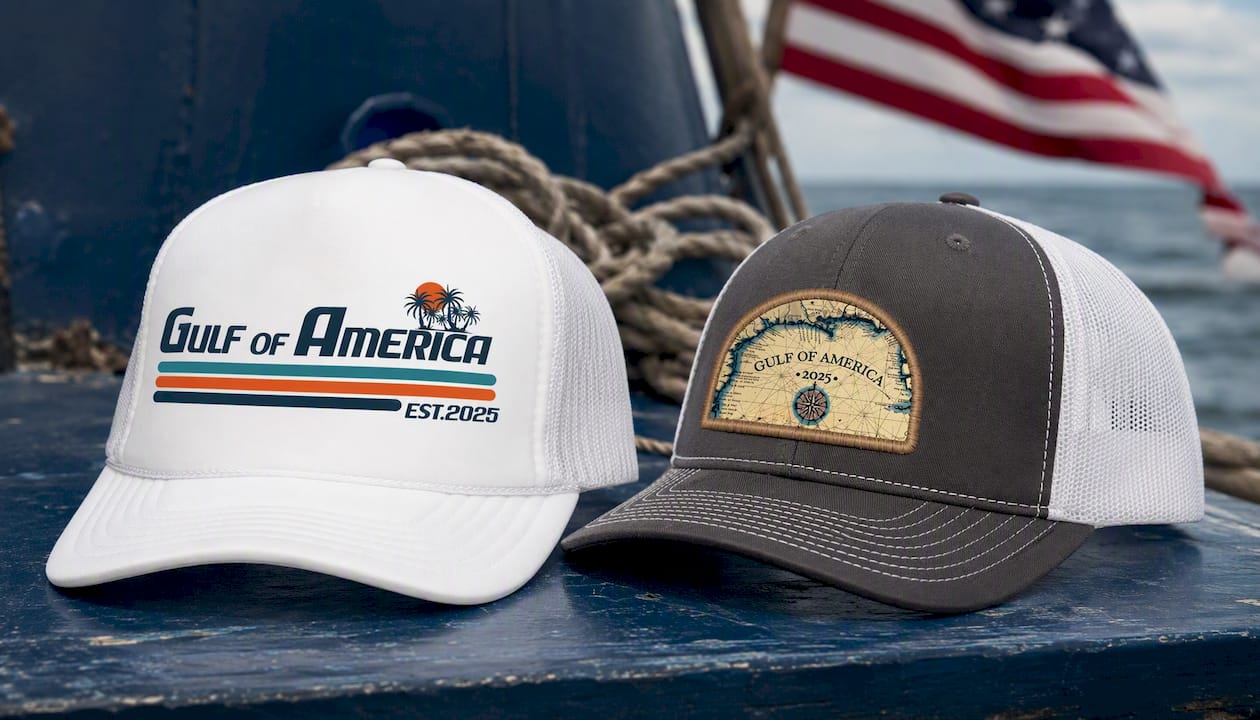
The Gulf of America Trucker Hat uses a classic snapback trucker build with a breathable mesh back, suited for everyday wear rather than a costume-y statement piece. If you want something a bit more detailed, the embroidered patch mesh-back trucker hat swaps a printed logo for a raised embroidered patch, which holds up better over years of washing and daily use.
Both come backed by the same 30-day money-back guarantee that’s helped earn over 2,400 positive customer reviews. If you’re deciding between the two, think about where you’ll wear it most: the standard trucker hat leans casual and everyday, while the embroidered patch version reads a little more deliberate, better suited for occasions where you want the detail to stand out up close. Browse the full Gulf of America collection to compare both side by side before you check out.
Where to Read More on the Gadsden Flag’s History
For primary historical grounding, Britannica’s entry covers Gadsden’s design and its naval origin. The U.S. Fish & Wildlife Service explains the rattlesnake’s natural-history symbolism, while PBS’s Iconic America series offers documentary context. The Conversation traces its shifting modern perception, and readers wanting Americana-themed art beyond apparel might browse FLY’s Americana collection as well.