

Get the Flag Patch Right: U.S. Army's 2" x 3" Rule and Where to Wear It
Wear the American flag patch with the union, the field of stars, facing forward. On a right sleeve, that means using a reversed “stars-forward” patch; on a left sleeve, use a standard patch. For flat placements on a hat or chest, the union sits uppermost and to the flag’s own right. Soldiers follow a stricter rule: a full-color or subdued flag, about 2" x 3", worn on the right shoulder pocket flap.
TL;DR:
- The stars-forward rule for flag patches on the right sleeve is based on the principle of an advancing flag, with the union leading into motion, not a mistake or error.
- The Army standard for patch placement is about 2 inches by 3 inches on the right shoulder pocket flap, using a hook-and-loop system for easy swapping between full-color and subdued patches.
- Civilian departments and organizations often follow the same stars-forward convention, but absence of a written policy means default choices should align with existing patches or standard placement norms.
- The Flag Code does not specify sleeve orientations but allows patches on uniforms for military and patriotic organizations, leaving civilian uniform rules to departmental policies or personal judgment.
- Proper maintenance, respectful disposal, and understanding the symbolic reason behind the stars-forward patch rule are more important than memorizing exact placement, especially outside military context.
Table of Contents
- Why Flag Patches Are Sometimes Reversed
- What the Flag Code Says (and Doesn’t) About Patches
- Army Placement Rules: Size, Side, and Hook-and-Loop
- Civilian and First-Responder Placement When There’s No Written Policy
- Flag Patches on Hats, Chests, and Everyday Gear
- The Origin of the Stars-Forward Rule
- What Correct and Incorrect Placement Actually Looks Like
- Common Mistakes People Make With Flag Patches
- Keeping Flag Patches Clean, Intact, and Respectful
- How Branches and Departments Differ on Placement
- Are There Legal Penalties for Wrong Flag Patch Placement
- Why Getting This Right Matters More Than Most Guides Admit
- Gulf of America Hats Built for Respectful Flag Display
- Sources
- FAQ
Why Flag Patches Are Sometimes Reversed
A flag carried by someone running forward would stream backward, with the union leading the way. That’s the whole logic behind the reversed patch. Picture a color guard advancing into a room. The stars are always at the front of the motion, never trailing behind like a flag flown from a stationary pole.
The Institute of Heraldry calls this the “advancing flag” or “stars-forward” principle, and it’s the reason a right-sleeve patch looks mirrored compared to the flag you’d see on a flagpole. It isn’t a printing error or a cheap knockoff. It’s deliberate heraldry.
This shows up in a few predictable spots:
- Right sleeve of a uniform: reversed, stars-forward patch
- Left sleeve: standard, non-reversed patch
- Plate carriers and tactical vests: usually mirrors the sleeve rule based on which side the patch sits
- Hat front panels: standard orientation, since a hat isn’t “advancing” in either direction
What the Flag Code Says (and Doesn’t) About Patches
The U.S. Flag Code addresses flags on poles and walls, not sleeves. Under 4 U.S.C. § 7, when a flag is displayed flat or projected horizontally, the union belongs uppermost and to the flag’s own right, which is the observer’s left.
The flag, when displayed with another flag against a wall from crossed staffs, should be on the flag’s own right, and its staff should be in front of the staff of the other flag.
That’s the closest the Flag Code comes to a placement rule, and it was written decades before flag patches on tactical gear were common. The code generally prohibits using the flag as clothing, but it carves out a specific exception. According to VA guidance on flag display, the code explicitly permits flag patches on uniforms for military personnel, firefighters, police officers, and members of patriotic organizations. Civilians outside those categories get no federal sleeve rule at all. That gap is exactly why agency regulations like AR 670-1 exist. They’re not interpretations of the Flag Code. They’re binding uniform standards written by the institutions that need consistency across thousands of service members.
Army Placement Rules: Size, Side, and Hook-and-Loop
AR 670-1 is the single most specific document on this topic, and it leaves almost nothing to guesswork. Soldiers wear the full-color U.S. flag embroidered insignia, roughly 2 inches by 3 inches, on the right shoulder pocket flap of the utility uniform. In field or deployed conditions, that swaps to a subdued, low-visibility version instead of full color.
Here’s what the regulation actually specifies:
- Placement: right shoulder pocket flap, centered
- Size: approximately 2" x 3"
- Full-color patch for garrison and standard duty
- Subdued patch for field, tactical, or deployed environments
- Patch goes on the uniform’s hook-and-loop pad, never sewn directly onto the fabric
That last point trips people up who are used to sewing patches onto civilian jackets. The Army’s hook-and-loop system exists so a soldier can switch between full-color and subdued flags in seconds without needle and thread, and without permanently altering government-issued clothing.
Pro Tip: If you’re replicating military placement on a civilian jacket or vest, use a hook-and-loop panel instead of sewing the patch directly. It lets you swap patches for different events without damaging the garment.
Civilian and First-Responder Placement When There’s No Written Policy
Most fire departments, police agencies, and EMS units set their own uniform rules, and many of them mirror the military’s stars-forward convention for the same reason the Army adopted it: consistency and instant visual recognition. If your department already has a uniform manual, that manual wins every time, even if it contradicts what you read here.
Absent a written policy, three steps will keep you on solid ground:
- Check your department’s uniform manual or standard operating procedures for a flag insignia section.
- Ask a supervisor or someone in logistics if there’s an unwritten but consistent practice among current staff.
- If neither exists, default to a left sleeve with standard orientation, or a right sleeve with the reversed stars-forward patch.
Either default choice is defensible and recognizable. What you want to avoid is guessing at an orientation that contradicts your own department’s existing patches, since a station full of mismatched flag directions looks careless rather than patriotic.
Flag Patches on Hats, Chests, and Everyday Gear
Civilian apparel gives you more room to make a judgment call, but the same underlying logic still applies. A few placements come up constantly:
- Hat front panel: standard orientation, since a cap isn’t simulating forward motion the way a sleeve is.
- Left chest: union uppermost, positioned toward the flag’s own right, which mirrors how a flag lapel pin sits near the heart.
- Right sleeve (jacket, backpack strap): reversed stars-forward, if you’re deliberately copying military convention.
Material matters more than people expect. Sewn patches last through washing and rough use but require a needle or a tailor. Hook-and-loop patches are faster to apply and swap, though the loop backing can catch on other fabric in a dryer or a crowded closet, so trim any fraying edges early. Some patched apparel, including patches applied to fashion pieces, treats the flag as a design element rather than a symbol, which is a different context from uniform or patriotic wear and worth keeping separate in your own mind.
Pro Tip: Avoid placing a flag patch anywhere that invites soiling: seat panels, shoe uppers, or disposable event giveaways. A patch that gets dirty fast gets disrespected fast, even unintentionally.
Skip disposable garments and single-use items entirely. When a patch frays past a reasonable point, retire it rather than continuing to wear it.
The Origin of the Stars-Forward Rule
The stars-forward convention didn’t come from a marketing decision or a modern uniform designer. It traces back to old cavalry and infantry practice, where a flag bearer carried the colors at the front of an advancing formation. The wind and the bearer’s forward motion pushed the fabric backward, so an observer looking at the advancing unit would see the union first, streaming ahead of the stripes.
Apply that same physics to a soldier’s right arm swinging forward while walking or running. A standard, non-reversed patch on that sleeve would show the union trailing behind, as if the flag were retreating rather than advancing. Flip the patch, and the union leads again, consistent with the historical image of colors carried into battle.
That’s why only the right sleeve gets the reversed version. The left arm swings backward relative to forward motion, so a standard patch on the left sleeve already shows the union in the “leading” position without needing to be mirrored. The two sleeves aren’t inconsistent with each other. They’re mirror images of the same underlying idea, applied correctly to each arm’s direction of travel.
This detail gets lost on a lot of people the first time they see a right-shoulder patch and assume someone stitched it on backward. It’s the opposite of an error. It’s a specific, historically grounded design choice that the Institute of Heraldry has documented and standardized for military use, and it’s spread into first-responder and civilian practice because the symbolism is easy to explain once you see the reasoning. Once you understand the advancing-flag logic, you’ll never look at a mirrored patch as a mistake again. It’s the same flag, oriented for motion instead of stillness.
What Correct and Incorrect Placement Actually Looks Like
Picture two soldiers standing side by side. One wears a standard, unreversed flag patch on the right shoulder. The other wears the properly reversed stars-forward version in the same spot. From a few feet away they might look identical to an untrained eye, but the difference is which side the stars sit on relative to the stripes.
On a correct right-sleeve patch, the union sits at the front edge, closest to the collar and chest, as if leading the body forward. On an incorrect placement, someone has mounted a standard, non-reversed patch on that same shoulder, so the stars appear to trail behind, near the back of the arm instead of the front.
Left-sleeve patches follow the opposite visual check. A correct left-sleeve patch uses the standard, non-reversed orientation, with the union again positioned toward the front of the body. An incorrect version would use a reversed patch on the left arm, which puts the stars at the back, the same visual error as an unreversed patch on the right.
For flat displays like hat panels or chest patches, the check is simpler: the union should sit in the upper corner closest to the wearer’s own right side, mirroring how a flag on a wall or lapel is positioned. A patch with the union in the lower corner, or reversed for no directional reason, breaks that convention.
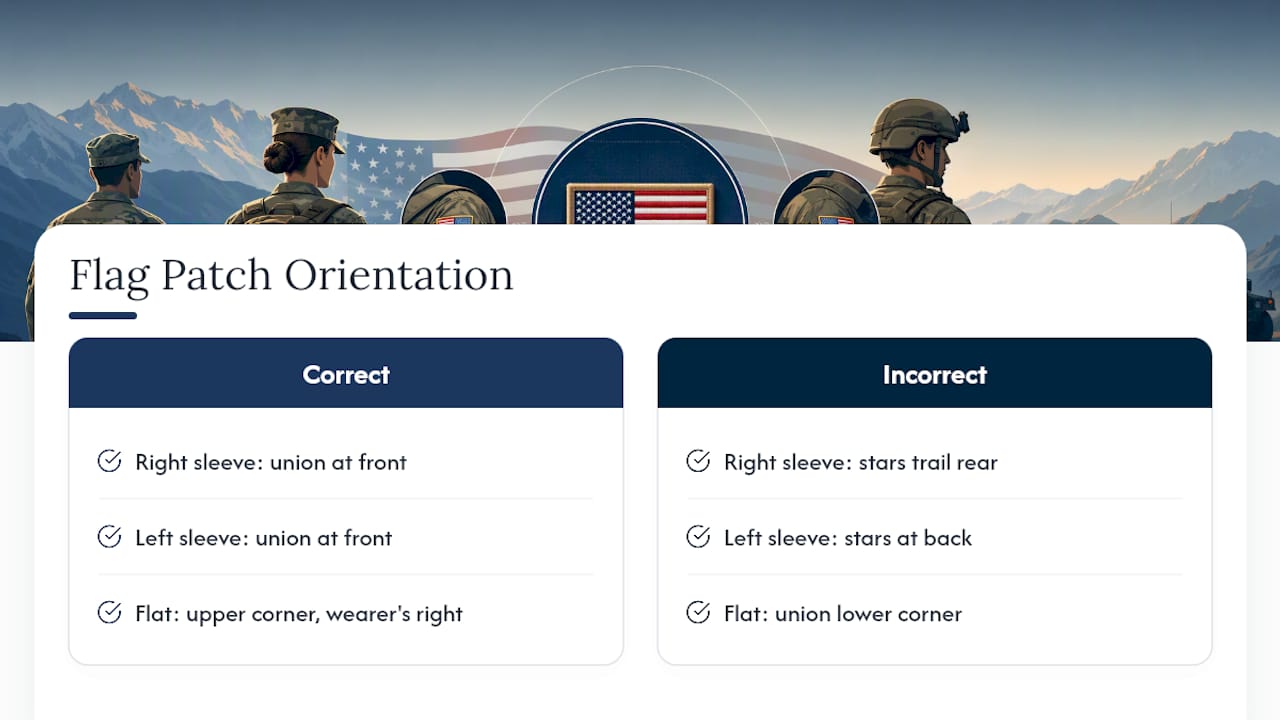
The fastest way to self-check a patch you’ve already applied is to compare it against a straightforward image: a flag being carried forward by someone walking toward you. Wherever the stars would naturally land in that image is where they belong on your sleeve.
Common Mistakes People Make With Flag Patches
The single most common error is applying a reversed patch to the left sleeve or a standard patch to the right sleeve, essentially flipping the rule instead of following it. This usually happens because people buy a patch without checking which version they’re getting, since reversed and standard patches often look nearly identical unless you’re specifically comparing them side by side.
A second frequent mistake is treating the stars-forward rule as universal for every placement on the body. It’s specific to sleeves and shoulder positions that simulate forward motion. A hat, a flat chest patch, or a backpack panel doesn’t need a reversed orientation, because none of those positions imply the same directional movement a sleeve does.
Third, some wearers assume the Flag Code dictates sleeve orientation, then get frustrated when they can’t find that language in the actual statute. As covered earlier, 4 U.S.C. § 7 covers flat and pole displays, not apparel placement. Sleeve rules come from agency regulations like AR 670-1, not the federal code itself.
A fourth mistake, more about maintenance than placement, is leaving a damaged or faded patch on a uniform or jacket well past the point it should have been replaced. A cracked, peeling, or heavily faded patch reads as neglect rather than pride, regardless of how correct the original placement was.
Finally, some civilians assume any placement is fine as long as it’s visible, then put a patch somewhere that gets routinely soiled or damaged, like a shoe upper or a seat panel. Visibility isn’t the standard. Respect is.
Keeping Flag Patches Clean, Intact, and Respectful
A flag patch that’s frayed at the edges, faded from repeated washing, or half peeled off a hook-and-loop pad doesn’t communicate pride, even if the original placement was flawless. Maintenance is part of the etiquette, not a separate concern.
For sewn patches, wash the garment inside out and skip high heat when drying, since heat is what breaks down embroidery thread fastest. For hook-and-loop patches, check the loop backing periodically. Once it stops gripping firmly, the patch will shift or fall off at the worst possible moment, and a crooked or half-detached flag patch looks worse than no patch at all.
When a patch reaches the end of its usable life, don’t just toss it in the trash with the rest of a worn-out garment. Retiring a damaged flag or patch respectfully is a recognized practice, and many VFW posts and Boy Scout units hold retirement ceremonies specifically for this purpose. If a local post isn’t practical, cutting the patch apart before disposal, separating it from recognizable flag form, is a widely accepted middle ground.
Rotating patches for different seasons or uniforms is fine, and it’s often smarter than wearing one patch until it disintegrates. Keep a spare on hand so a worn patch never has to stay in service past its useful life just because a replacement wasn’t ready.
How Branches and Departments Differ on Placement
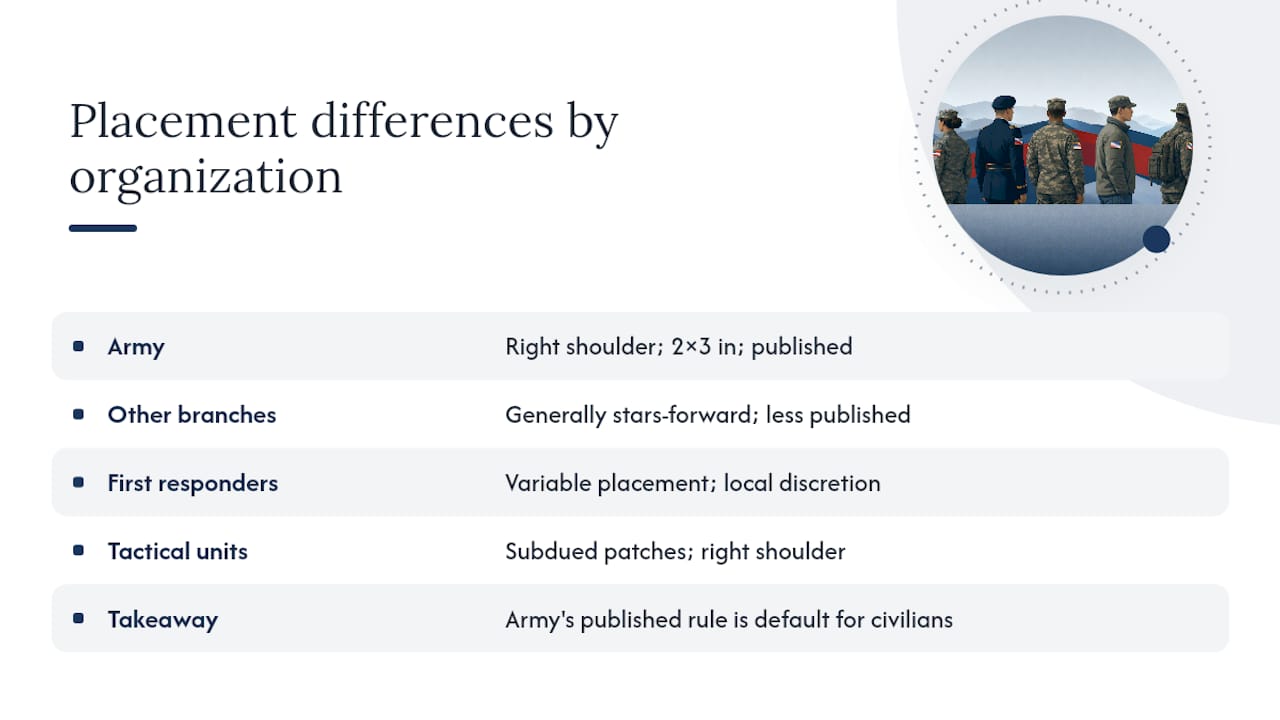
The Army’s AR 670-1 rule, right shoulder pocket flap, roughly 2 inches by 3 inches, full color or subdued depending on environment, is the most detailed and most frequently cited standard, largely because it’s published, specific, and easy to find. Other branches and departments don’t always publish comparably detailed guidance, but they generally follow the same underlying stars-forward logic even when their manuals phrase it differently or leave more discretion to unit-level leadership.
First-responder agencies vary more than the military does, mostly because there’s no single federal body setting uniform standards across every fire department, police force, and EMS unit in the country. Some departments adopt the military’s right-shoulder, stars-forward convention outright. Others place the flag on the left shoulder, on a chest panel, or leave the decision to individual precinct or station commanders. Departmental discretion is the norm here, not the exception.
Tactical and special operations units add another layer. Subdued or low-visibility patches are common in the field for the same reason camouflage exists: reducing visual signature matters more than displaying full color when concealment is operationally relevant. These patches still follow the stars-forward rule on the right shoulder. They just trade bright red, white, and blue for muted tones that don’t stand out against terrain.
The practical takeaway: if you’re a civilian trying to emulate “the” military standard, you’re really emulating the Army’s published version, since it’s the most accessible and most consistently enforced. Other branches and most first-responder agencies operate with more local flexibility, so don’t assume every uniform you see follows an identical rulebook.
Are There Legal Penalties for Wrong Flag Patch Placement
No federal statute imposes fines or criminal penalties on a civilian for wearing a flag patch in the “wrong” orientation. The Flag Code is a statement of respectful custom, not an enforceable civil or criminal law for individuals, and there’s no history of civilian prosecution for sleeve orientation.
The consequences that do exist are institutional, not legal. A soldier out of compliance with AR 670-1 can face a uniform correction, a counseling session, or in repeated cases, a note in a performance record, handled entirely within Army administrative channels rather than any court. A first responder violating a department’s uniform policy faces the same kind of internal discipline: a supervisor conversation, a policy reminder, or in serious or repeated cases, a formal write-up.
The one place actual legal exposure can appear is trademark or licensing law, and that’s a separate issue from placement entirely. Selling patches that improperly use a protected insignia, logo, or organizational emblem alongside a flag design can trigger trademark disputes, but that’s about intellectual property, not about which sleeve the stars face.
For nearly everyone reading this, the practical stakes are reputational, not legal. Getting the orientation backward on your own jacket won’t result in a ticket. It might result in a veteran, a service member, or a first responder quietly noticing, and that’s reason enough to get it right.
Why Getting This Right Matters More Than Most Guides Admit
Most placement guides treat this as a simple lookup: right sleeve reversed, left sleeve standard, done. That’s technically accurate, but it undersells how much the reasoning matters. Once you understand the advancing-flag principle, you stop needing a chart, because you can work out the correct orientation for any new placement, a plate carrier, a backpack strap, a jacket sleeve, just by asking which direction that surface faces during forward motion.
The conventional advice also underplays how much discretion exists outside the military. AR 670-1 is precise because it has to be, across hundreds of thousands of soldiers. First responders and civilians operate in a much looser space, and pretending otherwise creates false confidence that there’s one universal answer for everyone.
What I’d prioritize first isn’t memorizing sleeve rules. It’s understanding the underlying symbolism well enough to explain it if someone asks, and then checking whatever written policy actually governs your situation, whether that’s a department manual or your own judgment on a personal jacket. The patch matters less than the intent behind how it’s worn, and that intent shows up fastest when someone can explain, not just apply, the placement they chose.
— Erik
Gulf of America Hats Built for Respectful Flag Display
Some apparel brands design hats with the patch position pre-set for correct placement, removing guesswork about patch orientation.

The Gulf of America Hat Embroidered Patch Mesh Back Trucker Hat uses a standard-orientation embroidered patch on the front panel, consistent with the flat-display placement covered earlier: union uppermost, positioned toward the flag’s own right. For a more rugged option, the Gulf of America Leather Patch Trucker Hat uses a durable leather patch that holds up to daily wear better than a lighter embroidered version. The Gulf of America Trucker Hat – Patriotic Snapback Baseball Cap rounds out the lineup with an adjustable snapback fit.
Many orders come with a 30-day money-back guarantee, and this brand has received numerous positive customer reviews. Browse the full hats, shirts, and collectibles lineup and pick the option that fits how you plan to wear it.
Sources
- 4 U.S. Code § 7 - Position and manner of display
- AR 670-1: 21-19. Wear of U.S. flag embroidered insignia
- The Institute of Heraldry — FAQs about flag insignia
- VA — Flag display and handling guidelines
FAQ
Should the American flag patch go on the right or left sleeve?
Either sleeve is correct as long as the orientation matches. Right sleeve uses a reversed, stars-forward patch; left sleeve uses a standard, non-reversed patch, and the Institute of Heraldry documents this as standard military heraldry.
Why is the flag patch reversed on the right shoulder?
The reversal mimics a flag carried forward into motion, with the union leading rather than trailing behind the stripes. This “advancing flag” principle comes directly from Institute of Heraldry guidance and applies specifically to the right shoulder.
Is it legal for civilians to wear a flag patch?
Yes. The Flag Code generally restricts using the flag as clothing but explicitly permits patches on uniforms for military, fire, police, and patriotic organization members, according to VA guidance. Civilians wearing patches outside those categories face no federal restriction, only personal or employer judgment on placement.
What size should a military flag patch be?
Army regulation specifies roughly 2 inches by 3 inches for the full-color or subdued flag insignia worn on the right shoulder pocket flap, per AR 670-1. Civilian and first-responder patches vary more since there’s no single mandated size outside military regulation.
Should you fly the flag on the left or right side of your front door?
Displayed against a wall or in a window, the union should sit uppermost and to the flag’s own right, which appears as the observer’s left, following 4 U.S.C. § 7. This is a different rule from sleeve orientation, since a door display isn’t simulating forward motion the way a patch on an arm is.