

Ask for Martindale and GSM Before You Buy Durable T-Shirts
The tees that survive years of washing and wear share three traits: heavyweight or loopwheel knits, long-staple compact cotton, or engineered blends like Cordura and Dyneema®. Weight, fiber quality, and stitching each add resistance to abrasion and stress in different ways, and the combination is what separates a shirt that lasts two years from one that lasts ten. If you’re ready to shop, skip to the decision guide below.
TL;DR:
- Fabric weight and construction quality, including specific stitch types and reinforcement, are key factors in a shirt’s abrasion resistance and lifespan.
- Engineered synthetic blends with fibers like Dyneema® or Cordura can withstand 100,000 Martindale abrasion cycles, outperforming standard cotton by a wide margin.
- Long-staple, compact cotton provides a good balance of comfort and durability, especially when paired with reinforced stitching and quality yarns.
- Proper care, such as washing in cold water and avoiding heat, can significantly extend a shirt’s lifespan regardless of fabric type.
- Always verify durability claims with specific numbers like GSM and Martindale cycle counts rather than trusting vague marketing language.
Table of Contents
- What Makes a T-Shirt Durable, Exactly?
- Which Fabrics Actually Last the Longest?
- Which Construction Details Actually Prevent Early Failure?
- How Do You Wash Durable Shirts to Make Them Last?
- Which Durable T-Shirt Fits Your Use Case?
- The Publisher’s Take: How Gulfofamerica Chooses Durable Apparel
- Durability Myths That Waste Your Money
- What This Guide Gets Right That Most “Durability” Advice Misses
- Ready to Shop? What to Expect from Gulfofamerica
- Sources
- FAQ
What Makes a T-Shirt Durable, Exactly?
“Durable” gets used to describe everything from a $12 multipack to a $125 Japanese-knit tee, and that’s part of the problem. The actual industry term you want to know is abrasion resistance, measured through something called the Martindale test. A machine rubs a fabric sample against an abrasive surface in circular motions, counting cycles until visible wear appears. The higher the cycle count, the tougher the weave holds up to friction from work, backpacks, seatbelts, and everyday movement.
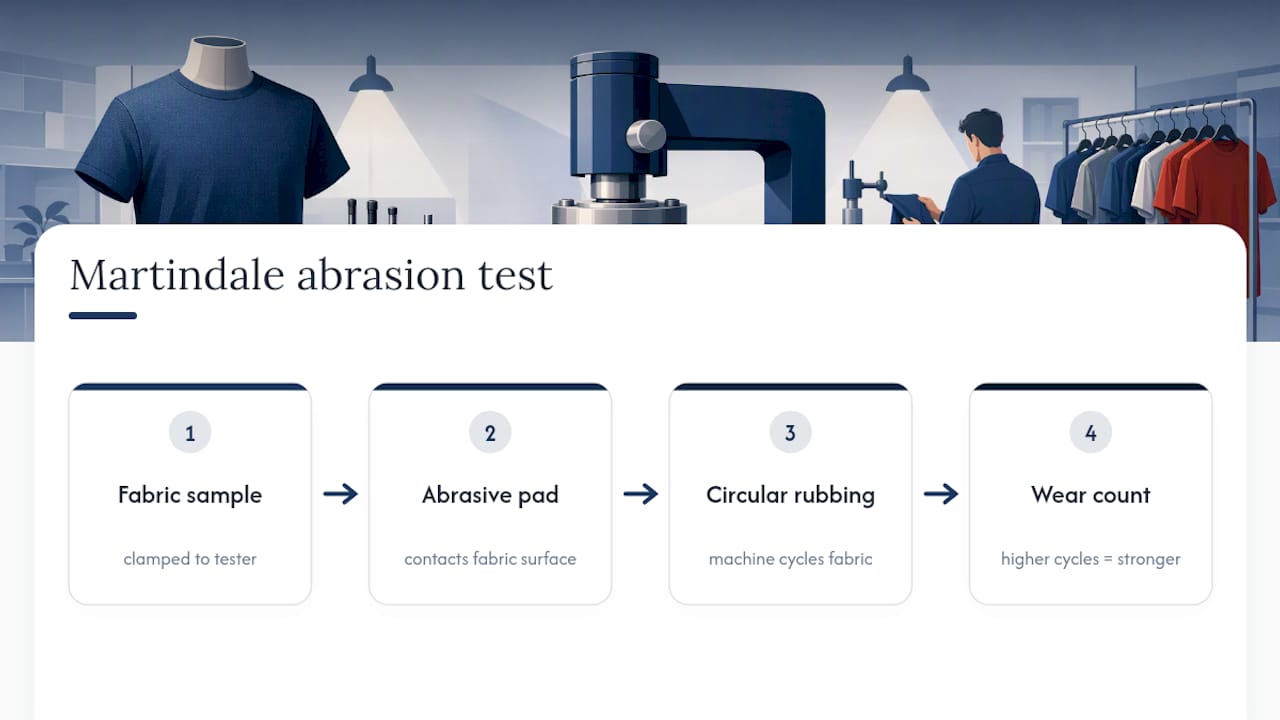
That single number, paired with fabric weight and construction quality, tells you more about how long a shirt survives your closet than any marketing phrase like “built to last” or “rugged fabric.” Here’s what to actually check before you buy.
Fabric weight and gsm ranges
Grams per square meter (gsm) measures fabric density. A flimsy fashion tee runs 120 to 140 gsm. Everyday durable cotton tees typically sit between 180 and 220 gsm. Heavyweight work shirts and loopwheel tees often exceed 220 gsm, sometimes reaching 300 or more. Heavier fabric resists thinning, stretching, and tearing, though it also runs warmer, so match the weight to your climate and use case, not just your durability goal.
Fiber quality and knit type
Look for long-staple or extra-long-staple cotton, combed cotton, and twofold (two-ply) yarns. Sunspel builds its classic tee from extra-long staple Supima cotton using a compact two-fold yarn specifically because longer fibers and folded yarn construction resist pilling and fiber breakage far better than short-staple, single-ply cotton. Loopwheel knitting, an older, slower production method, produces fabric with less tension in the loop structure, which helps the shirt hold its shape and resist stretching out at the collar and hem.
Construction details worth inspecting
- Twin-needle stitching on hems and sleeves prevents unraveling under repeated stress.
- Cover-stitch collars and reinforced shoulder seams stop the most common failure points: collar warping and shoulder-seam blowouts.
- Continuous-filament polyester thread, rather than cheaper spun thread, resists breaking during machine washing.
- Ribbed collar bands with proper elastane recovery keep their shape wash after wash instead of sagging.
Fit and how it affects lifespan
A shirt that’s too tight stresses seams every time you move, especially at the shoulders and underarms, the two spots that fail first on cheap tees. A shirt that’s too loose flaps and abrades against bags, tool belts, and machinery. The sweet spot is a fit with slight ease through the chest and shoulders and sleeves that end mid-bicep, keeping fabric away from repetitive friction points.
Pro Tip: If a product page only says “durable fabric” with no gsm, fiber type, or stitch detail, treat that as a red flag. Legitimate durability claims come with numbers. Email the seller and ask for the gsm and thread type directly. A brand confident in its construction will answer in one line.
Which Fabrics Actually Last the Longest?
Long-staple cotton, heavyweight knits, and engineered synthetic blends each solve durability differently, and knowing which one fits your situation matters more than chasing the single “best” fabric.
Long-staple and compact cotton wins on comfort-to-durability ratio. Longer fibers mean fewer loose ends poking out of the yarn, which is what causes pilling. Sunspel’s approach of pairing extra-long staple Supima cotton with two-fold yarn is a clear example of how fiber length and yarn construction, not just cotton as a category, drive longevity.
Heavyweight cotton jerseys built with thicker yarns add structural durability without leaving cotton’s comfort profile. Filson’s approach documents heavyweight cotton jerseys knitted with thicker yarns and reinforced construction as the brand’s answer to rugged, work-ready wear, offering both cotton and merino options depending on whether you need pure toughness or moisture management.
Engineered blends push abrasion resistance further than natural fibers can go alone. Vollebak’s Indestructible T Shirt blends just 5% Dyneema®, a fiber originally developed for industrial and military use, into a heavy cotton knit and reports passing 100,000 Martindale abrasion cycles with no visible wear. The brand’s 100 Year T Shirt takes a different route, using a cotton and polyamide Cordura blend with moderate fabric weight and claiming similar cycle performance, with Vollebak stating the fabric tests significantly stronger than a standard cotton tee.
By the numbers: A basic cotton tee typically wears through in a few thousand Martindale cycles under lab conditions. Engineered blends built with Cordura or Dyneema® have been tested to 100,000 cycles with no visible wear, a gap that explains why specialty blends cost more but survive years of heavy use that would shred ordinary cotton.
Where do merino and polyester blends fit? They’re not built primarily for abrasion resistance. Merino excels at odor control and temperature regulation, making it a better pick for travel and active use than for pure toughness against friction. If your priority is fewer washes and less stink over a long trip, merino earns its place. If your priority is surviving a warehouse shift or years of yard work, it doesn’t compete with heavyweight cotton or engineered blends on raw wear resistance.
A quick gut check for any manufacturer’s abrasion claim:
- Does the brand state an actual Martindale cycle number, or just say “tested for durability”?
- Does the fiber blend make sense for the claim (a pure cotton tee claiming 100,000 cycles should raise an eyebrow)?
- Is the weight (gsm) listed alongside the abrasion number, since a thin fabric with a high cycle count is unusual?
One nuance worth remembering: a strong fabric can still fail at a weak seam, so Martindale numbers should be weighed alongside garment construction, not treated as the whole story.
Which Construction Details Actually Prevent Early Failure?
Seams fail before fabric does in most durable tees. You can buy the toughest 100,000-cycle fabric on the market and still watch a shirt die at the collar or shoulder seam within a year if the construction is cheap.
Stitch type and thread matter more than most buyers realize. Vollebak’s production notes describe technical stitching using continuous-filament polyester thread rather than the cheaper spun-cotton thread common on fast-fashion tees. Continuous filament resists snapping under repeated stretch because it has no weak points where short fibers were twisted together.
Twin-needle stitching on hems and cuffs is the single easiest construction cue to spot in a product photo. Two parallel rows of stitching distribute stress across more thread, so a hem doesn’t unravel the first time it catches on a doorknob or work bench.
Seam placement and shoulder design decide whether a shirt tears under a backpack strap or overhead reach. Set-in sleeves with reinforced shoulder seams handle repetitive arm movement better than raglan cuts on cheap tees, where a single line of stitching runs straight across the highest-stress point on the whole garment.
Collar rib quality separates a shirt that looks new after 50 washes from one that looks stretched out after five. Ribbed collars with proper elastane content and a cover-stitch finish resist the sagging and rolling that plague low-cost crew necks.
Hems and cover-stitching keep the shirt’s shape through hundreds of wash and dry cycles. A cover-stitched hem lies flat instead of curling, which matters both for appearance and for reducing the fraying that eventually turns into a hole.
What to look for or avoid when scanning photos:
- Good sign: visible double rows of stitching at hems and sleeves.
- Good sign: a collar that sits flat and even in product photos, not wavy or loose.
- Warning sign: single-stitch hems with wide, loose thread spacing.
- Warning sign: thin, semi-transparent fabric at the shoulders where a stress-test photo would reveal seam puckering.
How Do You Wash Durable Shirts to Make Them Last?
Cold water and gentle cycles do more for a shirt’s lifespan than any fabric choice you make at checkout. Heat and agitation are what break down fibers, fade color, and warp collars, so controlling both is the entire game.
- Turn the shirt inside out before washing. This protects the outer surface and any printed graphics from direct friction against zippers, buttons, and other garments in the load.
- Wash in cold water on a gentle or normal cycle. Cold water reduces shrinkage and slows dye fading, especially on darker colors and printed tees.
- Use a mild detergent and skip fabric softener on cotton tees, since softener residue can weaken fiber structure over hundreds of washes.
- Air-dry when possible. Heat from a dryer is the fastest way to break down elastane in ribbed collars and cause shrinkage in cotton. If you must use a dryer, choose low heat.
- Handle prints separately. Wash printed tees inside out and skip high-heat drying or direct ironing over the graphic, since heat is the primary cause of print cracking and fading. Proper curing during manufacturing also extends how long a screen print survives repeated washing.
- Repair small tears early. A loose thread or small seam gap caught early takes five minutes to hand-stitch. Left alone, it grows into a hole that reinforced stitching can’t fix.
Pro Tip: A simple cost-to-life rule: if repairing a shirt costs less than a third of what a comparable replacement costs and the fabric is still structurally sound, repair it. Once the fabric itself is thinning or the collar rib has lost its stretch, no amount of stitching brings it back.
Which Durable T-Shirt Fits Your Use Case?
Work, outdoor activity, travel, and everyday wear each put different stress on a shirt, so the “most durable” answer changes depending on what you’re actually doing in it.
- Heavy manual work: favor engineered blends like Cordura or Dyneema®, or heavyweight cotton with reinforced shoulder seams. Abrasion from tools, ladders, and equipment demands the highest cycle-count fabrics you can find.
- Outdoor and active use: prioritize fast-drying blends or merino where moisture management matters as much as toughness. Abrasion resistance still counts, but breathability and odor control carry more weight for hiking, climbing, or travel-heavy trips.
- Everyday and travel wear: compact, long-staple cotton hits the best balance of weight, packability, and durability. You don’t need industrial-grade fabric for a daily commute, but you do want fiber quality that resists pilling after dozens of washes.
- Comparing two product pages fast: check gsm, stitch type, care instructions, and whether there’s a return or satisfaction guarantee before you commit.
| Use case | Material / construction | Weight (gsm) | Seam & stitch | Care complexity |
|---|---|---|---|---|
| Heavy manual work | Cordura or Dyneema® blend, or heavyweight cotton | 220 to 300+ | Reinforced shoulder seams, twin-needle hems | Low, machine washable |
| Outdoor / active | Merino or fast-drying synthetic blend | 180 to 220 | Flatlock seams to reduce chafing | Moderate, some hand wash |
| Travel / everyday | Long-staple compact cotton | 180 to 220 | Cover-stitch hems, ribbed collar | Low, cold wash and air dry |
The Publisher’s Take: How Gulfofamerica Chooses Durable Apparel
Erik, who covers apparel durability for this site, built this guide around one filter: does a manufacturer back its claims with a specific number, or just a slogan? That same filter shapes how Gulfofamerica sources apparel.
The brand prioritizes premium materials and construction that hold up to real daily wear, not just fabric that photographs well. Some products come with a 30-day money-back guarantee, so if a shirt or hat doesn’t meet your durability expectations once worn and washed, customers have options. Positive customer reviews can reflect satisfaction across many wears and washes, providing insights beyond lab test results.
If you’re comparing specs across product pages, compare fabric weight, stitching detail, and return policy the same way this guide teaches, then reach out to support with specific questions about construction. A brand confident in its materials should answer directly.
Durability Myths That Waste Your Money
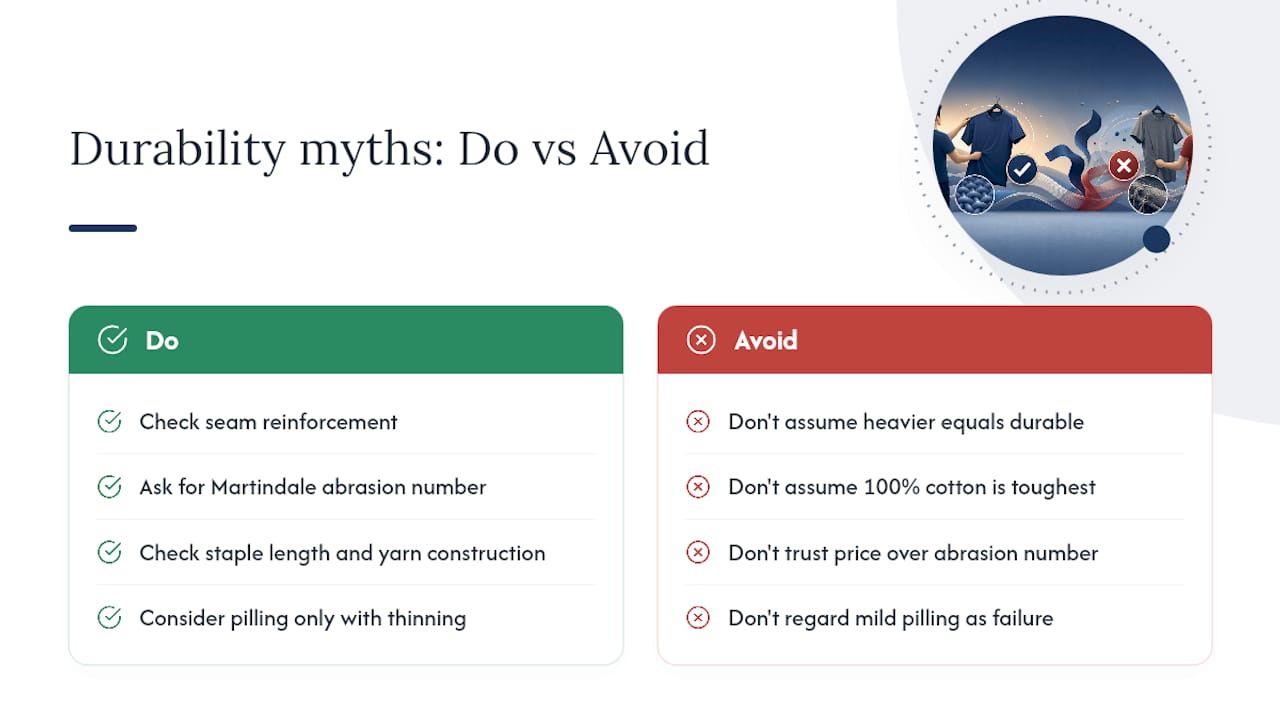
Myth: Thicker always means more durable. Weight helps, but a heavy shirt with weak seams still fails at the shoulder before a lighter shirt with reinforced stitching does. Weight is one input, not the whole formula.
Myth: 100% cotton is automatically the toughest option. Cotton quality varies enormously. Short-staple, single-ply cotton pills and thins fast, while long-staple compact cotton or Cordura blends outlast it by a wide margin. The fiber percentage on the tag tells you far less than the staple length and yarn construction.
Myth: A high price always means a high Martindale number. Plenty of premium-priced tees never publish an abrasion figure at all. Price reflects brand positioning as much as fabric science, so ask for the actual number instead of trusting the price tag.
Myth: Pilling means the shirt is falling apart. Mild pilling on the surface, especially in high-friction spots like underarms, is normal fiber behavior even on decent cotton. It becomes a real problem only when it’s accompanied by thinning fabric or visible holes.
Myth: A tighter fit shows off a better body, so tension at the seams doesn’t matter. Whether your stomach shows when you raise your arms has nothing to do with fabric quality. It’s a fit and sizing issue, and constant seam tension from an undersized shirt accelerates shoulder and underarm failure regardless of how tough the fabric is.
What This Guide Gets Right That Most “Durability” Advice Misses
Most articles on long-lasting tees repeat the same shallow advice: buy cotton, wash cold, done. That’s not wrong, but it skips the part that actually separates a two-year shirt from a ten-year shirt: verifiable test data and construction details you can check before you buy, not after.
The conventional wisdom oversells fiber content and undersells stitching. A 100% cotton label tells you almost nothing on its own. Staple length, yarn twist, and seam reinforcement do the real work, and manufacturers who publish Martindale numbers or specific gsm figures are giving you something you can actually verify, unlike vague phrases like “built tough.”
If I had to prioritize one thing for a reader shopping right now, it’s this: stop trusting adjectives and start asking for numbers. Weight in gsm, stitch type, and any abrasion test data will tell you more in thirty seconds than a full page of marketing copy.
— Erik
Ready to Shop? What to Expect from Gulfofamerica
The brand sells patriotic apparel that emphasizes durability principles such as material weight and construction quality, with some orders backed by a money-back guarantee. That guarantee matters because it puts the risk on us, not you, while you actually wear and wash the piece to see how it holds up.

Before you buy anything, patriotic apparel or otherwise, check the same three things this guide walks through: fabric weight, stitching detail, and return terms. On our site, start with the Gulf of America Hat Embroidered Patch Mesh Back Trucker Hat or the Gulf of America Trucker Hat, a patriotic snapback baseball cap, both built with the same construction standards discussed above. If you want to browse the full lineup of shirts, hats, and collectibles, visit the Gulf of America collection and check any product page against the checklist in this guide before you check out.
Sources
- 100 Year T Shirt. White edition – Vollebak
- Men’s T-Shirts: Durable Cotton & Merino Wool Tees – Filson
FAQ
Which T-Shirt Brands Are the Most Durable?
Brands that publish real construction data, like fiber staple length, gsm, and Martindale abrasion cycles, tend to outperform brands relying on vague claims. Vollebak, Sunspel, and Filson each document specific durability construction choices, from Dyneema® and Cordura blends to long-staple cotton and heavyweight jerseys.
Should Your Stomach Show When You Raise Your Arms?
That’s a fit and sizing question, not a durability one. A shirt riding up when you raise your arms usually means the body length or sizing is too short for your torso, and it has no bearing on fabric quality or how long the shirt will last.
What Is the Most Durable Material for T-Shirts?
Engineered blends combining cotton with Cordura or Dyneema® currently post the highest tested abrasion resistance, with Vollebak reporting 100,000 Martindale cycles with no visible wear. For pure cotton options, long-staple, compact, or heavyweight construction outperforms standard short-staple cotton.
What Is the Longest-Lasting T-Shirt?
There’s no single universal answer, since lifespan depends on care as much as fabric. Heavyweight loopwheel tees, long-staple compact cotton shirts, and engineered blends tested to high Martindale cycle counts all represent the categories most likely to outlast years of regular wear and washing.