

13 Star Truths: Betsy Ross Flag Meaning in U.S. and How to Display It
The Betsy Ross flag is a 13-star, 13-stripe American flag with white stars arranged in a circle on a blue canton. The circle is generally read as a symbol of unity among the original colonies, but the story that Betsy Ross designed and sewed it at George Washington’s request is a legend that surfaced almost a century later and has never been documented in Revolutionary-era records. What follows separates the parts historians can verify from the parts that became folklore.
TL;DR:
- The story that Betsy Ross designed the first 13-star flag at Washington’s request is unsubstantiated, as no contemporary evidence exists from the Revolutionary era.
- Betsy Ross was confirmed to be a flag-maker paid by the government in 1777, but there is no proof she personally created or designed the circular star pattern.
- The 1777 Flag Act did not specify star arrangements, allowing for variations such as staggered rows or circles, which became associated with different designs over time.
- The circular star pattern symbolizes equality among states, a common motif in art of the era, but it was not mandated by Congress or specifically linked to Ross.
- Flying a historic 13-star flag, including the Betsy Ross pattern, is legal, but proper etiquette involves respectful display and contextual understanding of its history.
Table of Contents
- What Is the Betsy Ross Flag Meaning Behind the Legend?
- Documentary Evidence and Scholarly View: Payments, Paintings, and the Limits of Proof
- The Flag Act of 1777 and Why the Circle Was Only One Option
- What Do the Stars, Stripes, Circle, and Colors Actually Mean?
- Where You’ll See the Betsy Ross Flag Today, and Why It Sparks Debate
- Is It Legal to Fly a Historic 13-Star Flag?
- Why Gulf of America Cares About Getting the History Right
- What the Historical Record Actually Tells You
- Betsy Ross Flag Gear for Your Own Display of American Pride
- Sources
What Is the Betsy Ross Flag Meaning Behind the Legend?
The name “Betsy Ross flag” refers to a specific pattern, not a specific flag she is known to have made. Betsy Ross was a real Philadelphia upholsterer and seamstress who ran a flag-making business during the Revolutionary War, and government records confirm she was paid for that work.
What can’t be confirmed is the family story that turned her into the flag’s inventor.
- Elizabeth “Betsy” Griscom Ross worked as an upholsterer in Philadelphia and took on flag-making contracts for the new government.
- Her grandson, William Canby, first told the origin story publicly in 1870, nearly a hundred years after the events he described.
- Canby presented the account to the Historical Society of Pennsylvania, claiming his grandmother told him Washington personally visited her shop to request a flag design.
- No letter, diary entry, newspaper account, or government document from the 1770s mentions Ross designing a flag or meeting with Washington about one.
The timing of the story’s debut matters as much as its content. The late 19th century was America’s Centennial era, a period thick with parades, exhibitions, and a hunger for patriotic origin stories that felt personal rather than institutional. A young seamstress meeting Washington in her sewing room was a far more relatable image than a committee resolution, and it gave American women and girls a founding figure who looked like them. Historians who’ve studied the legend, including researchers cited by Scotscoop’s historical review, note that the story filled an emotional gap the historical record never actually left open. It spread fast because it answered a question people wanted answered, even if the evidence to answer it properly didn’t exist.
Documentary Evidence and Scholarly View: Payments, Paintings, and the Limits of Proof
Here’s what actually holds up on paper. The Pennsylvania State Navy Board paid Betsy Ross on May 29, 1777, for making flags, a receipt that survives and is treated as strong evidence she was a working flag maker for the colonial government. That’s a fact. What isn’t a fact is that this payment proves she created the first national flag or designed the star pattern herself.
A useful way to separate the record from the legend:
- Confirmed: Ross ran a flag-making business and received government payment for flag work in 1777.
- Confirmed: She was an active, skilled tradeswoman in a male-dominated trade during wartime Philadelphia.
- Unconfirmed: That she personally designed the 13-star circular pattern.
- Unconfirmed: That she met with George Washington to discuss the flag’s design.
Visual sources add color but not proof. John Trumbull’s Revolutionary War paintings and various regimental flags from the period show star arrangements that circulated in visual culture at the time, but as Wikipedia’s entry on the Betsy Ross flag notes, a painting can show what a flag looked like without telling you who designed it or why. Attribution requires a paper trail, and that paper trail simply doesn’t connect Ross to the design.
The mainstream historian position, echoed by History, is straightforward: the “first flag” claim is unproven, but that doesn’t erase her significance. She remains a documented, verifiable participant in Revolutionary-era material culture, which is exactly why a family story about her had enough real substance to take hold in the first place.
The Flag Act of 1777 and Why the Circle Was Only One Option
Congress settled the basics on June 14, 1777, when the Marine Committee passed a resolution establishing the flag’s core elements: 13 alternating red and white stripes, and 13 white stars on a blue field, one for each state. What the resolution left out is the reason so many different flag designs exist from this era.
The text never specified how the stars should be arranged. No row count, no spacing, no circle requirement. That silence opened the door to real variation on the ground.
- Some flag makers arranged stars in staggered rows because it was faster and more consistent to sew.
- Others chose a circle because it was visually balanced and read clearly from a distance, useful on a ship’s flag snapping in the wind.
- A handful of surviving period flags use irregular clusters or offset grids, reflecting whatever pattern a local seamstress or unit favored.
Vexillologists, people who study flag design professionally, point out that this lack of specificity in the 1777 Act is precisely why no single “correct” historical arrangement exists. The circle became associated with Ross mainly through later popularity, not because the Continental Congress ever mandated it.
What Do the Stars, Stripes, Circle, and Colors Actually Mean?
Most of the symbolism attached to the flag today is a mix of genuine period intent and interpretation added decades later. It helps to know which is which.
The 13 stripes represent the 13 original colonies, and that meaning was intentional from the start. The stars carry a similar logic: they were meant to evoke a new constellation forming in the sky, a fitting image for a country that saw itself as a new political arrangement rather than a rebellion against an old one. Most surviving stars from the era are five-pointed, though six-pointed stars appear on some period flags and coins, largely because six-pointed stars were easier to cut from folded fabric using scissors.
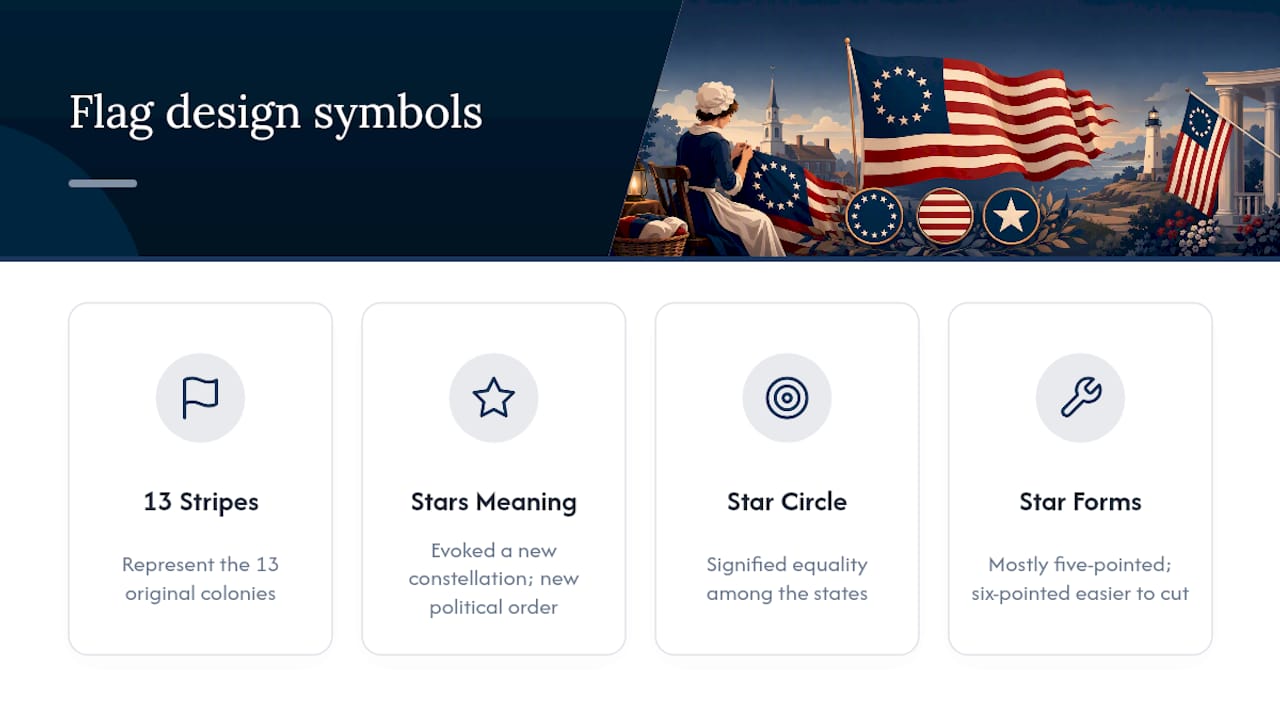
The circular arrangement carries the heaviest symbolic weight of any single design choice. In late-18th and early-19th-century art and coinage, a circle of stars commonly stood for equality among the states, since no single star sat above or below another. That reading shows up in engravings, coin designs, and some regimental flags well beyond any connection to Ross herself.
Colors are where people most often reach for meaning that wasn’t officially assigned in 1777. The commonly cited associations, red for valor and hardiness, white for purity and innocence, blue for vigilance, perseverance, and justice, actually trace back to the design of the Great Seal of the United States in 1782, not to any flag resolution. The Continental Congress left no record in 1777 explaining what the colors meant on the flag itself.
Pro Tip: If you want to sound informed rather than repeating internet trivia, say the color meanings come from the Great Seal, not the flag resolution. That one distinction trips up almost everyone.
Where You’ll See the Betsy Ross Flag Today, and Why It Sparks Debate
The 13-star circle pattern shows up constantly, and most of the time it’s genuinely uncomplicated. Museums display it as a Revolutionary War artifact. Reenactors fly it at historical events to represent the era accurately. Collectors and hobbyists buy reproductions, such as the Floral American Flag cross stitch pattern, because the design itself is striking, and educators use it to teach kids about the early republic.
Context is what determines how a viewer should read it, and a few cues make that read easier.
- Museum settings, school curricula, and battle reenactments treat the flag as historical, not political.
- Collectible and decorative uses, on porches, in home decor, at Fourth of July events, generally signal historical pride rather than a statement.
- The design has, at times, appeared alongside other symbols in political rallies or protests, which shifted public perception of it in certain settings.
- Location and company matter: a flag flown alone at a historic site reads very differently than one paired with unrelated political messaging at a demonstration.
Recent visibility spikes have often traced back to media coverage, viral social posts, or political controversies rather than any change in the flag’s original meaning. The design itself hasn’t changed since the 18th century. What changes is who’s using it and why, which is exactly the gap a thoughtful reader should check before assuming intent.
Is It Legal to Fly a Historic 13-Star Flag?
Yes. Flying a Betsy Ross flag or any historic 13-star variant is fully legal in the United States. The 1777 Flag Resolution never outlawed earlier or alternative designs, and there’s no federal statute banning historic American flag patterns from private or public display, a point confirmed by USHistory.org’s overview of Betsy Ross and the flag.
If you want to display one respectfully, a few practical steps go a long way:
- Treat a historic flag the same way you’d treat a current American flag: keep it clean, avoid letting it touch the ground, and don’t fly a damaged or faded one indefinitely.
- Illuminate it if you’re flying it after dark, or bring it in at sunset, following the same general etiquette outlined in the U.S. Flag Code.
- If you’re flying it alongside the current 50 star flag, position the current flag in the position of honor, typically higher or to its own right.
- At events or reenactments, pair it with clear historical context, a placard, a program note, so viewers understand you’re referencing 1777, not making a modern statement.
Why Gulf of America Cares About Getting the History Right
Gulf of America is a veteran-owned platform built on pride in American heritage, and that means the history behind a design like the Betsy Ross flag matters to us as much as how it looks on a hat. We sell patriotic apparel and collectibles made from premium materials, and we back every purchase with a 30-day money-back guarantee.
Many customers have left positive reviews reflecting they care about getting the details right, not just the aesthetic. When we curate heritage-themed pieces for events like the Fourth of July or Veterans Day, we lean on documented history rather than repeating whatever version of the legend is most popular online.
What the Historical Record Actually Tells You
The honest takeaway here is that most people get the Betsy Ross story backward. They assume the legend is either completely true or a modern myth invented to knock her down. Neither is right. She was a real, documented flag maker in a real Revolutionary-era business, and that fact got wrapped in a family story that outgrew its evidence.
The conventional advice on this topic tends to stop at “it’s a myth,” which flattens a more interesting truth: the legend persisted because it had just enough real substance to feel plausible, and it filled a cultural need for a personal, human-scale founding story. That’s worth understanding on its own terms, not just debunking.
If you take one thing from this, prioritize the distinction between what’s documented (her flag business, her 1777 payment) and what’s inherited folklore (the Washington meeting, the design credit). That distinction is the whole difference between history and legend, and it’s the one most casual retellings skip.
— Erik
Betsy Ross Flag Gear for Your Own Display of American Pride
Whether you’re setting up for a Fourth of July gathering or just want a daily reminder of the story behind the stars and stripes, Gulf of America carries pieces built for exactly that.

The Gulf of America Hat Embroidered Patch Mesh Back Trucker Hat pairs a breathable mesh back with a detailed embroidered patch, making it a solid everyday option for cookouts, tailgates, or just running errands with a little heritage on your head. If you’d rather go with a snapback fit, the Gulf of America Trucker Hat – Patriotic Snapback Baseball Cap delivers the same durable construction with an adjustable snap closure that works for most head sizes. Both are made from premium materials meant to hold up through real wear, not just look good in a photo.
Every order comes with our 30-day money-back guarantee, and you’re joining more than 2,400 customers who’ve already left positive reviews on fit, quality, and how the pieces held up over time. Browse the full collection of hats and pick the one that fits how you plan to wear your history.